
Compressed Air Problems
Common Problems Caused by Wet Compressed Air
Wet compressed air can damage pneumatic systems, increase downtime and reduce production reliability. Discover the most common problems caused by moisture inside industrial compressed air systems.
Common Problems Caused by Wet Compressed Air
Compressed air is often called the “fourth utility” in modern industry. However, when compressed air contains excessive moisture, it can become a major source of equipment failure and production instability.
Many factories experience recurring pneumatic problems without realizing that moisture contamination is the root cause.
Wet compressed air affects not only air pipelines, but also valves, cylinders, precision equipment and production quality.
Rust and Corrosion Inside Pneumatic Systems
One of the most common problems caused by moisture is corrosion.
When water remains inside pipelines and pneumatic components for long periods, rust gradually forms on internal metal surfaces.
Corrosion may damage:
- Air pipelines
- Pneumatic cylinders
- Machine spindles
- Air tanks
- Pneumatic connectors
Over time, rust particles can travel downstream and contaminate sensitive pneumatic components.
This significantly reduces equipment reliability and increases maintenance costs.
Solenoid Valve Failure
Solenoid valves are highly sensitive to moisture contamination.
Condensed water and rust particles may cause:
- Valve sticking
- Delayed response
- Internal corrosion
- Seal damage
- Unstable airflow control
For automated equipment operating continuously, even small valve failures can interrupt production lines and reduce operational efficiency.
Moisture-related valve failures are especially common in humid environments and systems with insufficient terminal air treatment.
Moisture Damage in CNC and Laser Equipment
Industries such as CNC machining and laser cutting require clean and stable compressed air.
Moisture contamination may lead to:
- Reduced machining precision
- Spindle corrosion
- Linear encoder damage
- Unstable pneumatic actuation
- Laser cutting quality defects
In high-precision applications, compressed air quality directly affects production consistency and equipment lifespan.
This is why many advanced manufacturing systems require additional air purification near the equipment inlet.
Increased Downtime and Maintenance Costs
Moisture problems often cause repeated equipment shutdowns and unexpected maintenance.
Factories may experience:
- Frequent replacement of pneumatic components
- Increased machine downtime
- Product scrap losses
- Lower production efficiency
- Higher maintenance labor costs
In many cases, the long-term cost of moisture damage is much higher than the cost of proper compressed air treatment.
Why Moisture Problems Still Exist After Air Dryers
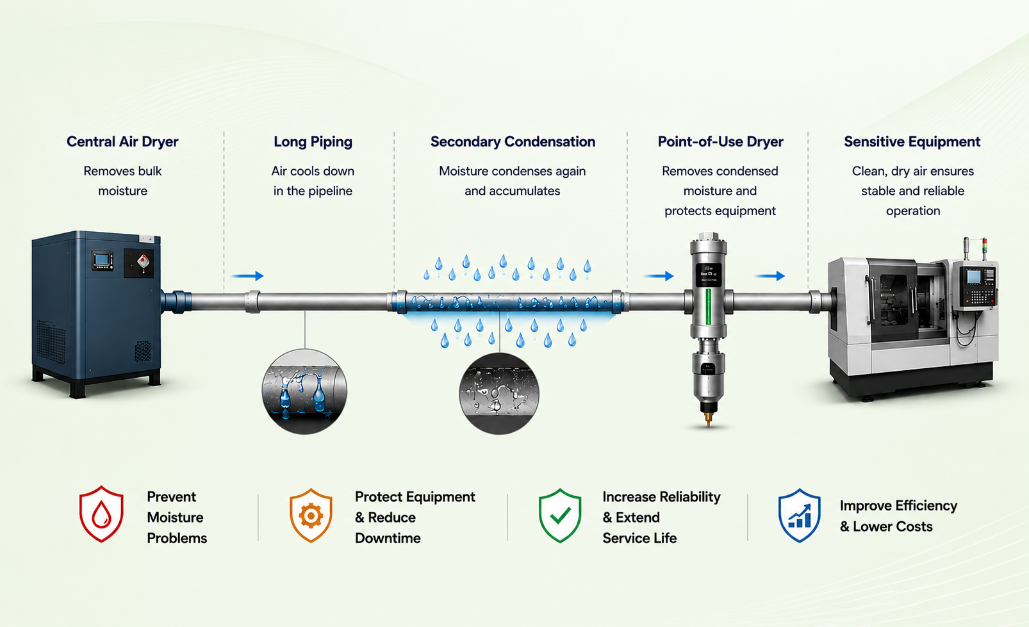
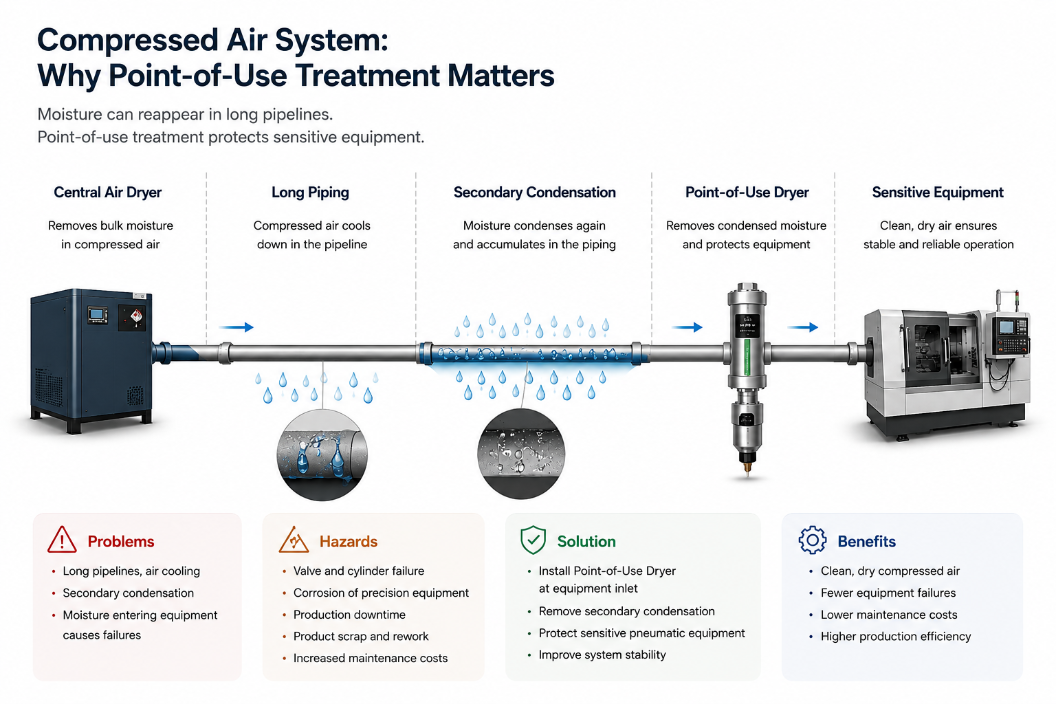
Many factories already install refrigerated air dryers or central filtration systems. However, moisture can still reappear inside pipelines due to secondary condensation.
As compressed air cools down during transportation, water vapor condenses again before reaching sensitive equipment.
This explains why some machines continue experiencing moisture-related problems even when central air treatment systems are functioning properly.
The Importance of Terminal Air Treatment
To improve equipment reliability, many manufacturers are now adopting point-of-use air treatment solutions.
By installing compressed air purification devices directly near the equipment inlet, manufacturers can remove terminal condensate before the air enters sensitive pneumatic systems.
This additional protection layer helps improve:
- Air quality stability
- Equipment lifespan
- Production reliability
- Maintenance efficiency
Conclusion
Wet compressed air can seriously damage pneumatic equipment and reduce manufacturing efficiency. Moisture contamination often causes corrosion, valve failure, unstable operation and production downtime.
As industrial systems become more automated and precise, terminal compressed air treatment is becoming increasingly important for protecting sensitive equipment and maintaining stable production performance.