
Is Your Automatic Timer Drain Emptying the Air Tank Between Shifts?
Is your automatic timer drain reducing receiver pressure between shifts? Learn how to distinguish scheduled discharge from leakage and choose suitable drainage.
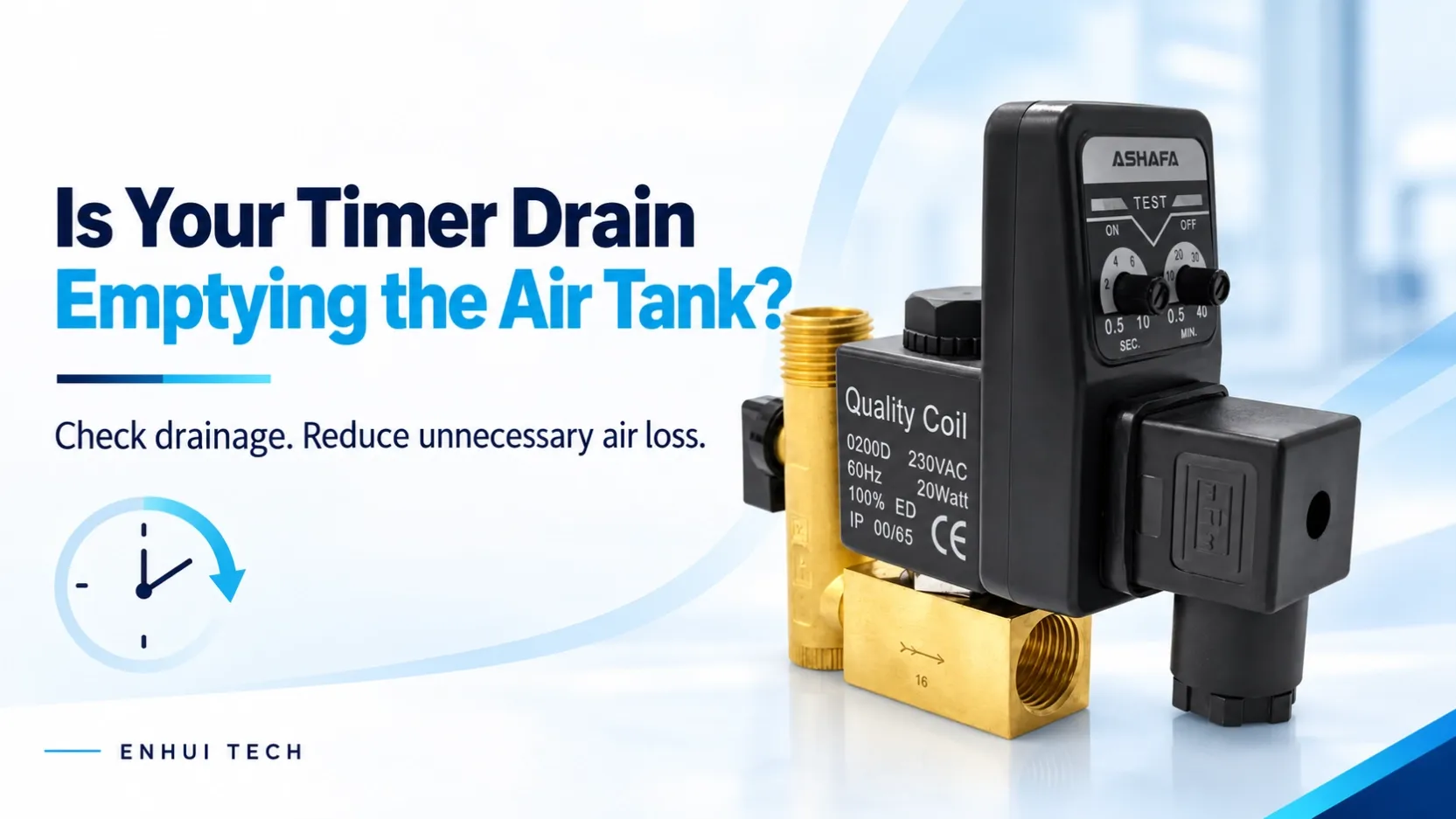
Your workshop closes, the compressor stops, but the automatic drain keeps releasing short bursts of air. By the next shift, receiver pressure has fallen.
Does this mean the drain is faulty?
Not necessarily. A timer drain operates according to its schedule, rather than the amount of condensate present. If it remains powered, it may continue opening while the compressor is idle.
Before replacing it, distinguish scheduled discharge from continuous leakage—and check whether other parts of the system are losing air.
Scheduled Discharge or a Valve That Will Not Close?
Observe the drain from a safe position during an approved inspection.
Short bursts at regular intervals can indicate normal timer operation. However, part of each opening may release air after the collected liquid has left.
Continuous airflow between cycles needs investigation. Contamination, a damaged seal or a valve-control problem may prevent proper closure. Changing the interval will not repair a valve that cannot seal.
A falling receiver pressure alone does not identify the drain as the cause. Hoses, connections and downstream equipment may also leak.
Why One Timer Setting Does Not Suit Every Workshop
A drain adjusted for a busy production shift may be unsuitable for occasional operation.
Condensate load changes with air consumption, humidity and operating conditions. The drain also needs enough open time to remove accumulated liquid.
Two settings matter:
- ON time: how long the valve remains open.
- OFF interval: the time between drainage cycles.
Opening too briefly may leave liquid behind. Opening longer than necessary can release additional compressed air.
Avoid copying another workshop’s settings without checking the result in your own installation.
Check the Off-Hours Arrangement
If a drain remains powered while the compressor is idle, repeated cycles can reduce stored pressure.
That does not mean every drain should simply be switched off overnight. Liquid may continue collecting as the system cools, and the equipment manufacturer may specify a particular shutdown or drainage procedure.
Ask your service technician to review the operating schedule and approved control arrangement. Do not bypass controls or modify electrical wiring as a shortcut.
Likewise, removing condensate and fully depressurizing a receiver are different tasks. Follow the compressor manufacturer’s instructions for both.
When a Timer Drain Remains a Practical Choice
A timer-controlled drain can suit applications with a reasonably predictable condensate load and regular inspection.
The ENHUI Split-Type Electronic Timer Drain Valve provides independently adjustable discharge duration and interval, together with a manual test function.
Check actual liquid discharge after adjustment. An audible click confirms neither adequate drainage nor proper sealing.
For broader fault diagnosis, see our Compressed Air Auto Drain Troubleshooting Guide.
When to Consider a Zero-Air-Loss Drain
If condensate load varies substantially, or repeated timed openings release air with little liquid, a demand-operated drain may be worth evaluating.
The ENHUI Zero Air Loss Automatic Drain Valve uses a mechanical liquid-level mechanism to discharge accumulated condensate.
Selection still depends on pressure, drainage capacity, contamination and installation requirements. It is not a substitute for maintenance, and savings cannot be calculated from the product name alone.