
Jul 22, 2026Compressed Air Problems
Why Machine-Side Compressed Air Protection Matters for CNC Reliability
Learn how liquid water in compressed-air lines affects CNC tool changers, pneuma
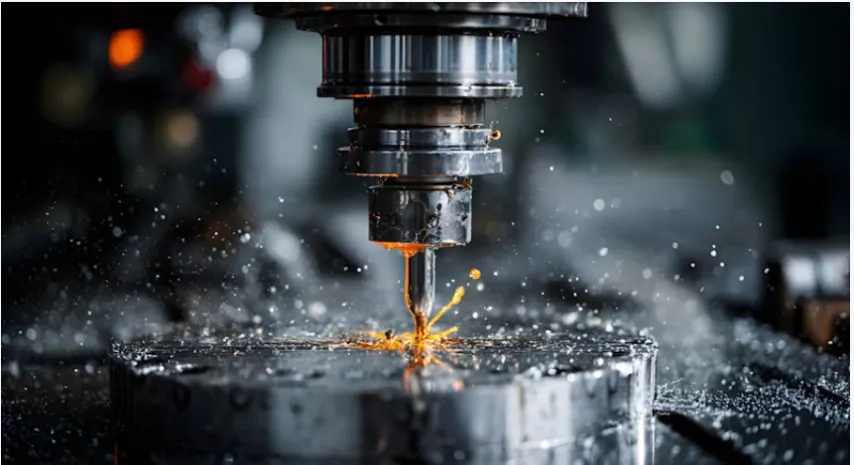
Modern CNC machines are becoming faster, more automated and increasingly capable of operating with limited human supervision.
However, the reliability of a CNC machine does not depend only on its controller, spindle or mechanical accuracy. Supporting systems—including compressed air—can also influence machine performance and downtime.
Liquid water reaching the machine inlet may affect pneumatic valves, cylinders, tool changers, fixtures and other air-operated components.
For CNC machine manufacturers, distributors and service companies, machine-side compressed-air protection can therefore become an important part of equipment reliability and after-sales service.
Machine Tool Investment Is Growing
Demand for manufacturing technology in the United States continued to grow strongly during the first five months of 2026.
According to the Association for Manufacturing Technology, new orders for metalworking machinery reached USD 583.4 million in May 2026, an increase of 47.8% compared with May 2025.
Total manufacturing technology orders during the first five months of 2026 reached approximately USD 2.77 billion, which was 31.9% higher than during the same period in 2025.
This growth reflects investment in areas such as automation, aerospace manufacturing, precision machining and advanced production equipment.
As manufacturers install more automated machines, the reliability of supporting utilities becomes increasingly important. A relatively small problem in a pneumatic valve, cylinder or fixture can interrupt an entire production cycle.
Source: Association for Manufacturing Technology, “$583.4M in New Machinery Orders Highlight US Economic Strengths,” published July 13, 2026.
View the original AMT report
How Do CNC Machines Use Compressed Air?
Compressed air performs several important functions in modern CNC machines.
Depending on the machine type and configuration, it may be used for:
- Automatic tool changing
- Tool clamping and unclamping
- Spindle air sealing
- Pneumatic chucks and collets
- Automatic machine doors
- Pneumatic fixtures
- Tool and workpiece cleaning
- Measuring and probing systems
- Lubrication-related functions
- Robotic loading and unloading
- Valves, cylinders and actuators
Some of these functions consume only a small amount of air, but they may be essential to the machining cycle.
For example, if a pneumatic cylinder does not reach its correct position, the next machine operation may not begin. If a valve sticks, an automatic door, fixture or tool-changing mechanism may stop working correctly.
Therefore, compressed-air quality should be considered part of overall machine reliability—not simply a factory utility issue.
How Does Water Reach the CNC Machine?
Compressed air naturally contains water vapor originating from the ambient air drawn into the compressor.
As compressed air moves through the system, it may experience changes in temperature and pressure. When the air cools sufficiently, part of the water vapor can condense into liquid water.
Condensation may occur in:
- Long compressed-air pipelines
- Branch lines located far from the compressor room
- Low points in the piping network
- Flexible hoses near machines
- Areas with large day-and-night temperature changes
- Humid manufacturing environments
- Intermittently operated pipelines
- Pipes installed near cold walls, floors or air-conditioning outlets
As a result, the air condition at the compressor room may not always be identical to the condition at the CNC machine inlet.
Even when upstream air-treatment equipment is operating normally, additional liquid water may form further downstream under certain installation and environmental conditions.
What Problems Can Moisture Cause in CNC Pneumatic Systems?
Liquid water entering a CNC machine may contribute to several types of operational problems.
1. Pneumatic valve sticking
Moisture, corrosion products and contamination may accumulate inside valves, affecting their response and movement.
A valve that operates inconsistently can cause intermittent faults that are difficult for maintenance teams to diagnose.
2. Unstable cylinder operation
Water and contamination may affect seals, lubrication and internal surfaces. The cylinder may move slowly, irregularly or fail to reach the required position.
3. Tool-changing problems
Many machining centers use compressed air during tool clamping, spindle sealing, cleaning or tool-changing operations.
Unstable air supply or contaminated pneumatic components can affect the reliability of these functions.
4. Fixture and clamping issues
Pneumatic fixtures must apply consistent force and reach the correct position. Unstable operation may affect machining consistency or trigger machine alarms.
5. Corrosion inside components and pipelines
Long-term exposure to moisture may contribute to corrosion in metal components, valves, fittings and downstream pipelines.
6. Increased maintenance and after-sales calls
Technicians may repeatedly replace valves, cylinders or seals without identifying the condition of the compressed air entering the machine.
For machine manufacturers and distributors, this can create avoidable service visits and customer complaints.
Why Checking Only the Compressor Room May Not Be Enough
Compressed-air systems are often evaluated at the compressor outlet or immediately after the main dryer.
However, the CNC machine may be located a considerable distance from that measurement point.
Between the compressor room and the machine, air passes through:
- Main distribution pipes
- Branch lines
- Isolation valves
- Flexible tubing
- Fittings and connectors
- Local air-preparation units
Temperature changes and poor drainage along this route can change the condition of the air.
For this reason, when moisture-related problems occur, inspection should include the actual machine inlet—not only the central compressed-air equipment.
A useful troubleshooting process is to compare air conditions at multiple points:
- After the main air-treatment equipment
- At the branch line supplying the machine
- Immediately before the machine inlet
- After local filters or air-treatment components
This can help identify where liquid water is forming or accumulating.
A CNC Machine Inlet Air Checklist
Machine builders, installers and service engineers can use the following checklist during commissioning or troubleshooting.
Air pressure
Confirm both the normal operating pressure and minimum allowable pressure at the machine inlet.
The measurement should be taken while the machine is consuming air, not only when it is idle.
Peak air flow
Some machine operations—including tool changing, chuck operation or air blowing—may create short periods of high air demand.
Air-treatment components and piping should be sized according to peak flow, not only average consumption.
Pressure drop
Check whether the piping, filters, fittings or local treatment devices cause excessive pressure loss.
A treatment device should provide protection without restricting critical machine functions.
Visible liquid water
Inspect drain points, filter bowls, branch lines and low points for liquid condensate.
Visible water usually indicates a different problem from water vapor or pressure dew point.
Pipeline layout
Check for low points, long horizontal pipelines, undersized tubing and locations exposed to significant temperature changes.
Drainage
Ensure that separated condensate can be discharged reliably.
A separator without effective drainage may eventually allow accumulated liquid to continue downstream.
Contaminant type
Determine whether the actual problem involves:
- Liquid water
- Water vapor
- Solid particles
- Oil aerosol
- Oil vapor
- A combination of contaminants
Different contaminants require different treatment technologies.
Liquid Water and Water Vapor Are Not the Same Problem
When a customer says that compressed air “contains water,” it is important to clarify what type of moisture is present.
Liquid water
Liquid water consists of visible droplets or condensate that has already formed inside the system.
Mechanical water separators and point-of-use centrifugal devices can be used to separate this liquid from the airflow when correctly sized and installed.
Water vapor
Water vapor remains in gaseous form and cannot be removed by a conventional mechanical separator.
Controlling water vapor requires drying technology selected according to the required pressure dew point, such as a refrigerated or desiccant dryer.
This distinction is important because no single air-treatment device solves every compressed-air quality problem.
ISO 8573-1 classifies compressed-air purity according to three main contaminant categories: particles, water and oil. The required purity level should be determined by the actual application rather than by a general claim that the air is “clean” or “dry.”
Where Does Point-of-Use Moisture Protection Fit?
A point-of-use air dryer or centrifugal water separator is installed close to the machine or individual air-consuming equipment.
Its primary role is to remove liquid water that has already condensed before that water enters sensitive pneumatic components.
It can be particularly useful when:
- Liquid water repeatedly appears near the machine
- The machine is located far from the compressor room
- Downstream pipes experience significant temperature changes
- Modifying the entire factory air system is impractical
- A repair company needs a local solution for a specific machine
- A machine builder wants to provide additional inlet protection
However, point-of-use separation should not be presented as a replacement for upstream drying when the application requires a defined pressure dew point.
The correct system may involve several stages, each performing a different function.
Opportunities for Machine Tool Manufacturers
Machine tool manufacturers can consider point-of-use moisture protection during the design and commissioning stages.
Possible configurations include:
- Standard installation on selected machine models
- An optional machine air-protection package
- A configuration for humid operating environments
- Additional protection for automated or unattended machines
- A retrofit kit for existing customers
The commercial value is not limited to the price of the component.
A suitable machine-side protection solution may help reduce moisture-related service calls, improve the completeness of the machine configuration and provide distributors with an additional accessory to offer customers.
Opportunities for CNC Distributors and Service Companies
Distributors and repair companies frequently encounter air-quality problems after the machine has already been installed.
Possible symptoms include:
- Water found in the local filter bowl
- Repeated pneumatic valve failure
- Unstable cylinder movement
- Tool-change alarms
- Water discharged from hoses
- Frequent manual drainage
- Similar faults returning after component replacement
Instead of immediately replacing another valve or cylinder, the service team should inspect the incoming compressed air.
A point-of-use moisture separator can become part of a retrofit solution when liquid condensate is confirmed near the machine inlet.
This approach allows service companies to provide more than a replacement component: they can address one of the possible causes of repeated failure.
Selecting a Point-of-Use Air Dryer for a CNC Machine
The following information should be collected before selecting a model:
- Machine type and application
- Normal and peak air flow
- Working pressure
- Inlet and outlet connection sizes
- Compressed-air temperature
- Ambient temperature
- Available installation space
- Amount and form of moisture
- Required pressure drop
- Drainage requirements
- Target air-quality level
Flow and connection size should not be selected independently.
A large port does not automatically guarantee that a device can handle the required flow with an acceptable pressure drop. Likewise, selecting equipment only according to average consumption may create restrictions during peak air demand.
A Small Component Can Protect a Critical Process
As CNC machines become more automated, the reliability of every supporting system becomes more important.
Compressed air may not be the most visible part of a machine, but it supports many critical operations—from tool changing and spindle sealing to clamping and robotic handling.
Liquid water at the machine inlet can contribute to unstable operation, maintenance work and unexpected downtime.
For machine builders, distributors and service companies, checking compressed-air quality at the actual point of use can help identify problems that may be missed when only the compressor room is inspected.
The objective is not to install unnecessary treatment equipment. It is to understand the contaminant, identify where it forms and apply the correct protection at the correct location.
Need Help Selecting Machine-Side Moisture Protection?
ENHUI TECH provides point-of-use air dryers and pneumatic components for CNC machines, precision equipment and industrial automation applications.
Our point-of-use air dryers are designed to separate liquid condensate near the equipment inlet without electricity or replaceable filter elements.
To recommend a suitable model, please provide:
- Equipment type
- Air flow
- Working pressure
- Connection size
- Operating environment
- Photos or videos of the moisture problem
Contact us to discuss a suitable machine-side air-treatment solution for your application.