
Aug 10, 2026Compressed Air Problems
Why Is There Still Water in Compressed Air Lines After an Air Dryer?
Still finding water after your air dryer? Discover the common causes of downstream moisture and how to protect CNC machines and pneumatic equipment.
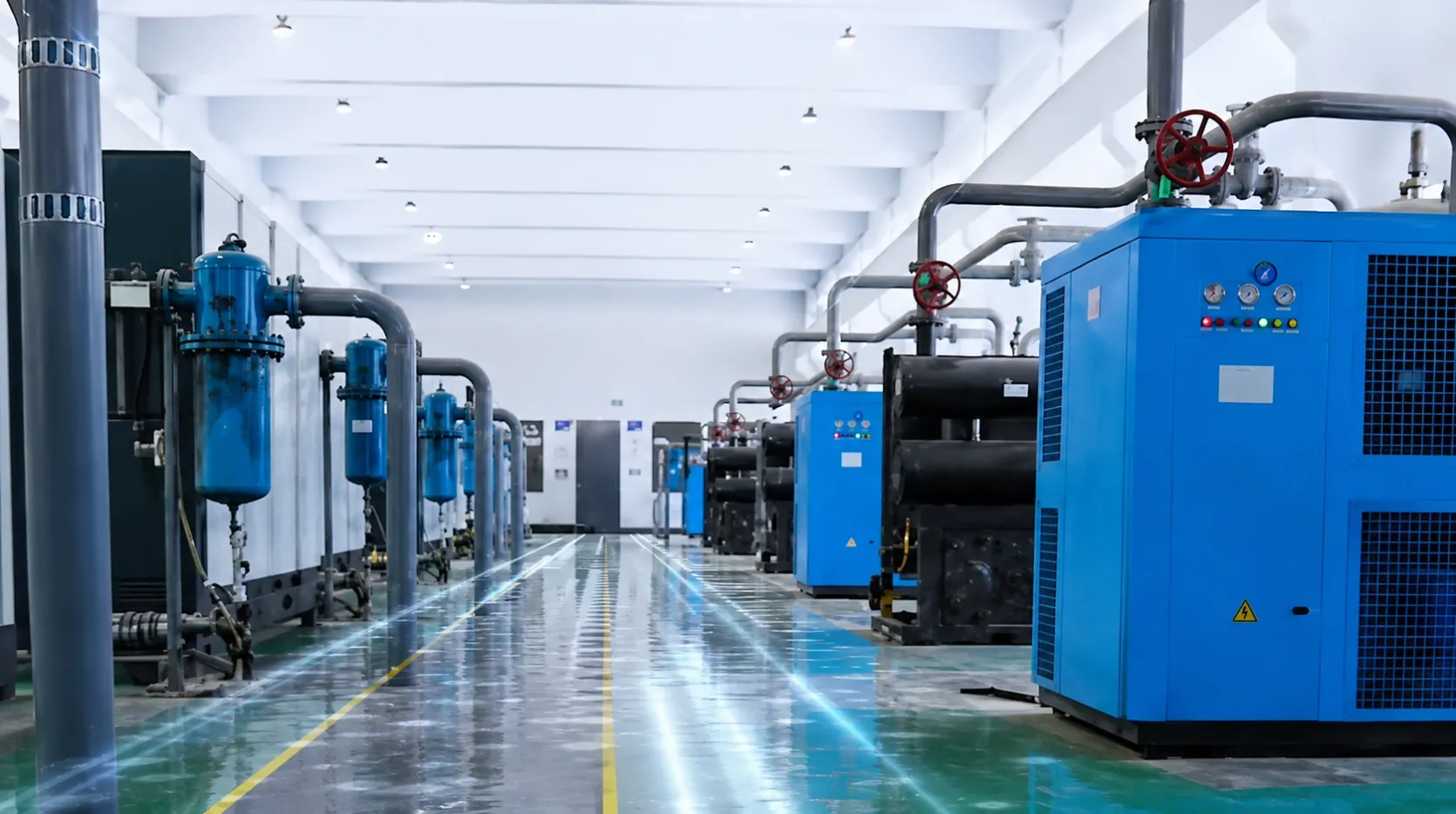
Finding water in a compressed air line after an air dryer can be confusing.
The factory has already invested in drying equipment, yet liquid water still appears at CNC machines, pneumatic valves, air tools or production lines.
This does not always mean the dryer is completely ineffective.
Moisture can remain in the system, form again inside downstream piping or bypass the treatment equipment through another route.
To solve the problem, it is important to identify where the water forms and whether the contaminant is water vapor, liquid droplets or a mixture of water and oil.
What Does an Air Dryer Actually Remove?
An air dryer primarily reduces water vapor in compressed air and controls the pressure dew point.
Different dryer technologies provide different dew-point performance.
A refrigerated dryer is commonly used for general industrial compressed air. A desiccant dryer is used when a much lower pressure dew point is required.
A dryer does not eliminate the need for:
- Water separators
- Compressed air filters
- Automatic drains
- Correctly designed piping
- Regular maintenance
- Point-of-use protection where necessary
If liquid water enters the dryer in large quantities, the dryer may be overloaded or unable to operate efficiently.
Nine Reasons Water May Appear After an Air Dryer
1. The dryer is undersized
A dryer must be selected according to actual airflow, operating pressure and inlet temperature.
If production expands or additional machines are connected, the air demand may exceed the original dryer capacity.
During periods of peak demand, compressed air may pass through the dryer too quickly to achieve the expected performance.
Check whether the dryer capacity has been corrected for:
- Actual inlet temperature
- Ambient temperature
- Operating pressure
- Maximum airflow
- Required pressure dew point
The nominal flow rating alone may not represent the available capacity under real factory conditions.
2. The inlet air is too hot
Refrigerated dryers have a specified maximum inlet temperature.
If the aftercooler is dirty, ventilation is poor or the compressor room is too hot, compressed air may enter the dryer above the recommended temperature.
Hotter air can hold more water vapor and creates a higher moisture load.
Check:
- Compressor discharge temperature
- Aftercooler cleanliness
- Cooling fan operation
- Cooling-water condition
- Ventilation around the compressor and dryer
- Air temperature at the dryer inlet
Reducing the inlet temperature can improve dryer performance and increase the amount of condensate removed before the air enters the dryer.
3. Bulk liquid is entering the dryer
An air dryer should not be expected to handle unlimited quantities of liquid water.
If the aftercooler separator, receiver drain or upstream filter drain fails, bulk condensate may enter the dryer.
This can reduce performance and damage downstream components.
Inspect the separators and drains located before the dryer. Confirm that they are discharging condensate rather than simply making an operating sound.
A drain may cycle normally while its outlet is blocked.
4. The automatic drain is not working
Condensate must be removed from separators, receivers, filters and refrigerated dryers.
A drain can fail because of:
- Blocked discharge tubing
- Dirt inside the valve
- Incorrect timer settings
- Loss of electrical power
- A damaged float mechanism
- Excessive back pressure
- Freezing
- Incorrect installation
When a drain fails, accumulated water may be picked up by the airflow and carried downstream.
Drain inspection should therefore be part of routine compressed air maintenance.
5. The dryer is bypassed
Many air-treatment systems include a bypass line so production can continue during maintenance.
If a bypass valve is open, leaking or incorrectly positioned, part of the compressed air may travel around the dryer.
The resulting wet air then mixes with the treated air downstream.
Check the complete pipe arrangement and verify the position of every isolation and bypass valve.
This is particularly important after maintenance or system modifications.
6. The dryer needs maintenance
A dryer may continue running even when its performance has deteriorated.
Possible problems include:
- Dirty heat exchangers
- Refrigeration-system faults
- Insufficient refrigerant
- Failed temperature sensors
- Incorrect control settings
- Saturated desiccant
- Damaged switching valves
- Excessive purge-air loss
- Poor regeneration
Do not judge dryer performance only by checking whether the power indicator is on.
Measure the pressure dew point and compare it with the expected value.
7. Compressed air cools again inside the distribution pipeline
Compressed air may leave the dryer under acceptable conditions and then cool further as it travels through the factory.
This can happen when pipelines pass through:
- Air-conditioned rooms
- Outdoor areas
- Underground sections
- Cold production zones
- Areas with large day-and-night temperature differences
If the compressed air temperature falls below its pressure dew point, additional vapor can condense into liquid water.
This explains why the compressor room may appear dry while water is found near a distant machine.
8. The piping system traps condensate
Incorrect pipe design can allow water to collect and move toward production equipment.
Common piping problems include:
- Main lines without sufficient slope
- Machine drops taken from the bottom of the main pipe
- Missing drip legs
- Low points without drains
- Dead-end pipe sections
- Flexible hoses that form water traps
Machine connections should normally be taken from the top of the main distribution pipe, with suitable drain points installed at low sections.
Correcting the piping layout can sometimes solve the problem without changing the dryer.
9. Residual water remains inside old pipelines
A newly repaired or upgraded dryer does not immediately remove water that has already accumulated throughout the distribution system.
Old pipelines may contain:
- Standing condensate
- Rust
- Compressor oil
- Sludge
- Contaminated filter material
This material may continue moving downstream after the original dryer problem has been corrected.
The system may require draining, cleaning, inspection or temporary point-of-use protection while the remaining contamination is removed.
How to Find the Source of the Water
Avoid replacing components before confirming where the problem begins.
Inspect the compressed air system in sequence:
- Check the compressor discharge and aftercooler.
- Inspect the separator and wet receiver drains.
- Measure the dryer inlet temperature.
- Verify the dryer pressure dew point.
- Confirm that bypass valves are closed.
- Inspect downstream filters and drains.
- Check low points in the distribution piping.
- Compare conditions near and far from the compressor room.
- Inspect the air directly at the affected machine inlet.
This step-by-step approach helps distinguish a dryer problem from a drainage, piping or downstream condensation problem.
Should You Install a Larger Air Dryer?
Not necessarily.
A larger dryer may be appropriate when the existing unit is genuinely undersized. However, it will not correct every cause of downstream water.
Increasing dryer capacity will not fix:
- A failed drain
- An open bypass valve
- Poor pipeline slope
- Water trapped in old piping
- Condensation created by local temperature changes
- Contamination entering downstream of the dryer
Identify the source before investing in new central equipment.
When Does Point-of-Use Separation Help?
A point-of-use liquid separator is installed close to the equipment air inlet.
It can provide additional protection when:
- Liquid water occasionally reaches a critical machine
- Long pipelines create downstream condensate
- Seasonal humidity affects air quality
- Central treatment cannot be upgraded immediately
- One machine requires better protection than the rest of the factory
- A machine manufacturer wants to integrate final-stage liquid protection
A point-of-use separator removes liquid droplets. It does not reduce water vapor or replace a properly selected central air dryer.
If the application requires a lower pressure dew point, the dryer system must still be evaluated.
Protecting CNC and Automation Equipment
CNC machines rely on compressed air for functions such as:
- Tool changing
- Pneumatic clamping
- Spindle-air sealing
- Automatic doors
- Air blow
- Valve and cylinder operation
Residual liquid water and oil droplets may cause valves to stick, cylinders to move irregularly and pneumatic components to fail prematurely.
Because these problems occur at the machine, checking only the compressor room may not reveal the actual air condition reaching the equipment.
Installing final-stage separation close to the machine inlet can help prevent liquid contamination from reaching sensitive pneumatic components.
A Practical Moisture-Control Strategy
A reliable compressed air system may combine:
- Effective aftercooling
- Bulk liquid separation
- Reliable automatic drainage
- Correctly sized air drying
- Appropriate filtration
- Properly designed distribution piping
- Point-of-use liquid separation at critical equipment
Each component has a different function.
When water appears after a dryer, investigate the entire system instead of assuming that one product must solve every moisture problem.
ENHUI point-of-use compressed air liquid separators remove residual liquid water, oil droplets and particulates before compressed air enters the equipment.
They require no electricity or conventional filter-element replacement and can be installed in existing compressed air systems.
To evaluate a suitable model, provide the equipment airflow, operating pressure, pipe size and details of the moisture problem.