
Aug 24, 2026Compressed Air Problems
Why Is There Still Water in Compressed Air Lines After a Refrigerated Air Dryer?
Still finding water in compressed air lines after an air dryer? Learn why condensation happens and how point-of-use liquid separators protect equipment.
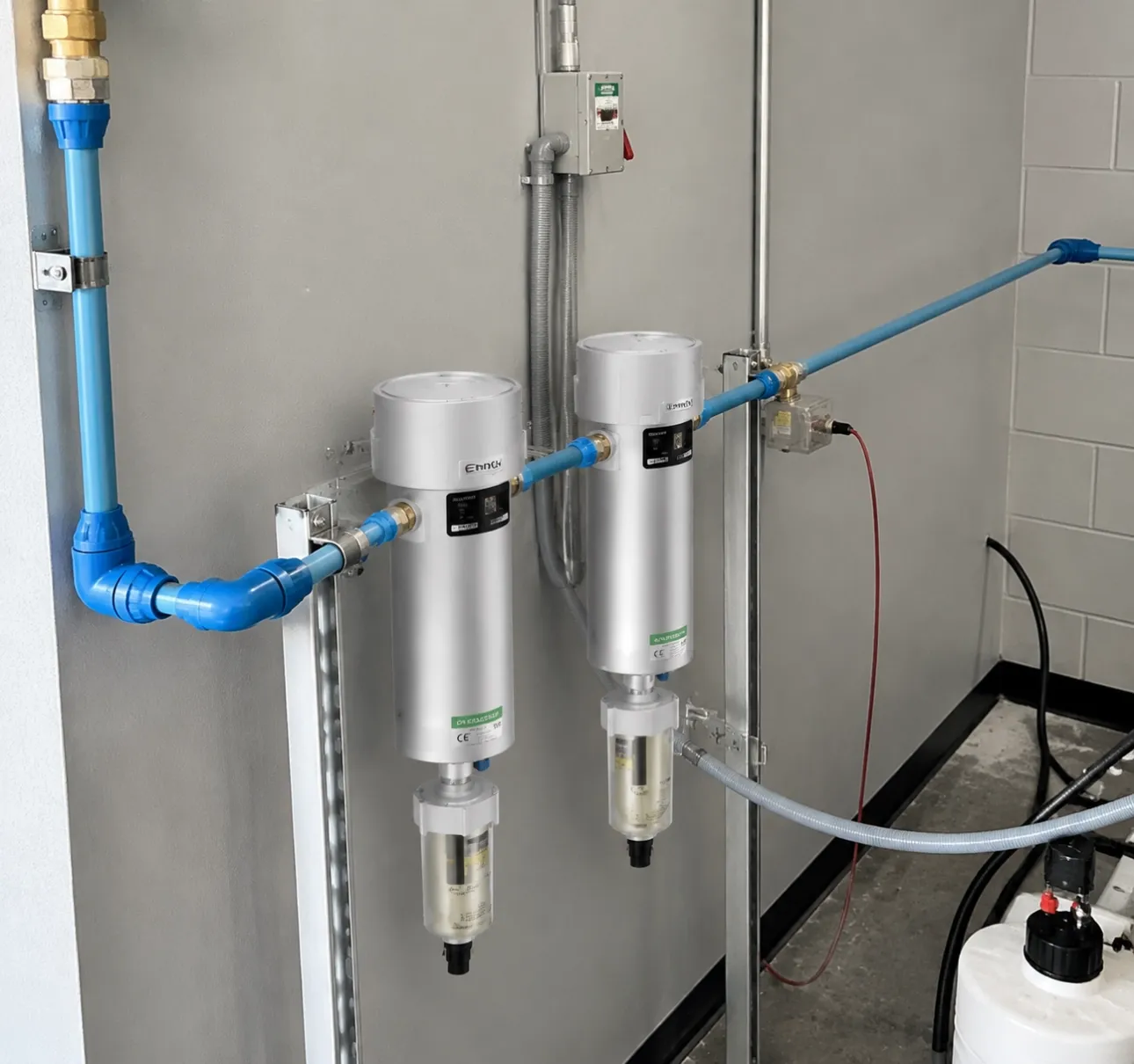
Many factories run into the same confusing problem:
The refrigerated air dryer is operating normally. Filters are installed. Compressor pressure looks stable. But water still appears in the compressed air line near the machine.
Sometimes the water collects at low points in the piping. Sometimes pneumatic valves or cylinders become unstable. In more sensitive applications such as CNC machining, laser cutting, painting, or automation, moisture can even affect equipment reliability and product quality.
The first reaction is often:
“Is the air dryer failing?”
Not necessarily.
A refrigerated air dryer can be working properly while liquid water still appears farther downstream.
The key is to understand where that water comes from, how pressure dew point works, and what happens to compressed air after it leaves the dryer.
Water Vapor and Liquid Water Are Not the Same Problem
Before troubleshooting, it is important to separate two different forms of moisture in compressed air:
- Water vapor
- Liquid water or condensate
A refrigerated air dryer mainly reduces water vapor by cooling compressed air until part of the vapor condenses into liquid water. That condensate is then removed through the dryer’s drainage system.
However, compressed air leaving the dryer still contains some water vapor.
If downstream conditions change, especially if the air cools further, some of that remaining vapor can condense again.
This is why:
Compressed air that has already passed through an air dryer can still develop liquid water farther downstream.
What Is Pressure Dew Point?
Pressure dew point, or PDP, is one of the most important concepts in compressed air moisture control.
In simple terms:
Pressure dew point is the temperature at which water vapor in compressed air begins to condense into liquid water at the current operating pressure.
For example, if compressed air has a pressure dew point of +5°C, the moisture will generally remain in vapor form as long as the compressed air temperature stays above +5°C.
If the air later cools below that temperature, condensation can occur again.
This means that the room temperature alone does not determine whether water will appear inside the pipe.
What really matters is:
the actual compressed air temperature inside the piping compared with its pressure dew point.
Why Can Water Appear After a Refrigerated Air Dryer?
Several conditions can cause liquid water to appear downstream even when the dryer itself is operating normally.
1. The Compressed Air Cools Further in the Piping
This is one of the most common causes.
After leaving the dryer, compressed air may travel through:
- Outdoor piping
- Long metal pipelines
- Air-conditioned areas
- Cold production zones
- Unheated workshops
- Areas with large day-to-night temperature changes
Metal piping can lose heat quickly.
If the compressed air temperature falls below its pressure dew point, water vapor can condense again inside the pipeline.
As a result, the dryer outlet may appear normal while liquid water is found tens or even hundreds of meters downstream.
2. Existing Condensate Can Be Carried Downstream
Not all downstream water is newly formed condensation.
Liquid water may already be collecting in parts of the compressed air system such as:
- Air receiver tanks
- Pipe low points
- Filter housings
- Branch lines
- Flexible hoses
- Valve manifolds
If this condensate is not drained properly, high-speed airflow can pick it up and carry it farther downstream.
Eventually, that liquid water may reach the machine inlet.
This is why troubleshooting should include the entire condensate management system, not just the air dryer.
3. Automatic Drains May Not Be Working Properly
Compressed air systems usually have several condensate drainage points, including:
- Air compressors
- Aftercoolers
- Air receiver tanks
- Refrigerated air dryers
- Coalescing filters
- Pipeline low points
A failure at just one of these locations can increase the amount of liquid water traveling downstream.
Common problems include:
- Clogged drains
- Stuck float mechanisms
- Blocked drain lines
- Failed drain valves
- Manual drains that are not opened frequently enough
- Water accumulating inside filters
A dryer may be operating correctly while a failed drain elsewhere in the system causes moisture problems at the point of use.
4. The Air Dryer May Be Operating Outside Its Rated Conditions
The rated capacity of a refrigerated air dryer is normally based on specific operating conditions, such as:
- Inlet air temperature
- Ambient temperature
- Working pressure
- Airflow
When actual conditions become more demanding, dryer performance can change.
Typical examples include:
- High summer temperatures
- Increased compressor discharge temperature
- Sudden increases in air demand
- Long periods of operation near maximum capacity
- Dirty condensers
- Poor ventilation around the dryer
Under these conditions, the actual outlet pressure dew point may increase.
Therefore, it is not enough to ask:
“Is the dryer running?”
A better question is:
“Is the actual pressure dew point still meeting the application requirement?”
Why Does the Problem Often Appear at the Point of Use?
Compressed air usually has to travel a long distance between the compressor room and the final machine.
A typical central compressed air treatment system may look like this:
Air Compressor → Air Receiver → Air Dryer → Filters → Main Piping → Machine
The central dryer may be working properly, but the compressed air still has to travel through the entire distribution system.
During this journey:
- The air may cool further
- Condensation may form inside the piping
- Existing condensate may be carried downstream
- Drain valves may fail
- Oil droplets and particulate contamination may remain in the air stream
That is why the actual compressed air condition at the machine inlet can be different from the condition measured near the compressor room.
For critical equipment, point-of-use air quality should be considered separately.
What Is the Role of a Point-of-Use Compressed Air Liquid Separator?
If the main problem at the machine inlet is already-formed contamination such as:
- Liquid water
- Oil droplets
- Particulate matter
a point-of-use compressed air liquid separator can be installed before the equipment as an additional layer of protection.
It is important to understand that a liquid separator and an air dryer perform different functions.
Refrigerated Air Dryer
Primary function:
Reduce water vapor and lower the pressure dew point of compressed air.
Point-of-Use Liquid Separator
Primary function:
Separate liquid water, oil droplets, and particulate contamination that is already present in the compressed air stream.
They are not direct substitutes.
A more complete compressed air treatment strategy can include:
Central drying + proper drainage + good piping design + point-of-use liquid separation
This approach addresses both moisture in vapor form and liquid contamination near the final machine.
Which Applications Are More Sensitive to Water at the Machine Inlet?
CNC Machines
Compressed air is commonly used for:
- Tool changing
- Spindle air purge
- Pneumatic clamping
- Solenoid valves
- Cylinders
- Air blowing
If liquid water repeatedly reaches pneumatic components, it can increase the risk of corrosion, sticking valves, unstable movement, and premature component wear.
Installing a point-of-use separator before the CNC machine can provide additional protection against downstream liquid contamination.
Industrial Automation
Automation systems often contain many:
- Solenoid valves
- Pneumatic cylinders
- Actuators
- Precision pneumatic components
Stable and clean compressed air helps reduce unexpected pneumatic failures and maintenance problems.
If liquid contamination occasionally appears in the plant air network, point-of-use separation can help protect sensitive downstream components.
Painting and Spray Applications
Liquid water and oil droplets in compressed air can reach spray guns and affect:
- Surface finish
- Paint consistency
- Coating defects
- Color uniformity
- Rework rates
For painting applications, the compressed air quality at the actual spray point is more important than simply knowing that a central dryer has been installed.
Laser and Other Sensitive Equipment
Some laser and precision applications have strict compressed air requirements.
In these applications, it is important to verify:
- Pressure dew point
- Oil content
- Particle contamination
- Actual air quality at the equipment inlet
If the equipment requires a very low dew point, a suitable drying system must be used.
A liquid separator does not replace a dryer when the process itself requires lower water vapor content.
However, where the required dew point has already been achieved and the remaining concern is liquid water, oil droplets, or particles reaching the machine, point-of-use separation can provide additional final protection.
Refrigerated Air Dryer vs Desiccant Dryer vs Liquid Separator
These three types of equipment solve different compressed air quality problems.
Equipment | Main Function | Typical Application |
|---|---|---|
Refrigerated air dryer | Reduces water vapor and pressure dew point | General industrial compressed air |
Desiccant air dryer | Achieves a much lower pressure dew point | Precision, low-temperature, and moisture-sensitive applications |
Liquid separator | Separates liquid water, oil droplets, and particulates | Downstream and point-of-use equipment protection |
If an application requires a pressure dew point of -20°C, -40°C, or lower, appropriate drying technology should be selected.
If the central dryer already provides an acceptable dew point but liquid condensate still reaches the machine, the problem may be better addressed through drainage, piping improvements, or point-of-use liquid separation.
How to Troubleshoot Water in Compressed Air Lines After a Dryer
If water is appearing at the machine even though the refrigerated dryer is operating, check the system in the following order.
1. Check the Dryer Outlet Pressure Dew Point
Do not rely only on whether the dryer is switched on.
Confirm that the actual pressure dew point is within the expected range.
2. Check Air Receiver and Filter Drains
Look for:
- Blocked drains
- Excess condensate
- Failed automatic drain valves
- Water collecting inside filter housings
3. Inspect Pipeline Low Points
Long compressed air lines often have locations where condensate collects.
Check whether these low points have suitable drainage.
4. Check the Piping Environment
Pay particular attention to:
- Outdoor piping
- Long metal pipelines
- Cold production areas
- Air-conditioned spaces
- Winter operating conditions
These areas may cause additional downstream cooling and condensation.
5. Check the Air Directly at the Machine Inlet
If the problem only occurs at certain machines, inspect the compressed air condition close to those machines rather than relying only on measurements near the compressor room.
6. Confirm the Actual Air Quality Requirement
Different applications require different compressed air quality levels.
Check the equipment manufacturer’s requirements for:
- Pressure dew point
- Oil content
- Particle level
- Working pressure
Then determine whether the best solution is improved central drying, better condensate management, or additional point-of-use protection.
A More Complete Approach to Compressed Air Moisture Control
Effective moisture control usually requires more than one piece of equipment.
A typical treatment strategy may include:
Cooling
Reduce compressed air temperature so that a large portion of water vapor condenses.
Air Storage
Allow additional condensate to separate inside the air receiver.
Automatic Drainage
Continuously discharge condensate from receiver tanks, filters, dryers, and piping low points.
Drying
Use refrigerated or desiccant drying technology to control pressure dew point.
Filtration
Reduce oil aerosols and particulate contamination.
Point-of-Use Liquid Separation
Install a liquid separator before critical equipment to capture residual liquid water, oil droplets, and particulates before they enter the machine.
When Should You Consider a Point-of-Use Liquid Separator?
A point-of-use liquid separator may be useful when:
- Liquid water occasionally reaches the machine inlet
- Long compressed air pipelines are used
- The distribution piping experiences large temperature changes
- Condensate is occasionally carried downstream
- Pneumatic equipment is sensitive to water contamination
- You want an additional protective stage before CNC, automation, painting, or other equipment
- The central dryer already meets the required dew point, but liquid contamination is still present downstream
The key is to identify the form of moisture first.
If the problem is water vapor or an insufficient pressure dew point, improve the drying system.
If the problem is liquid water that has already formed or has been carried downstream, liquid separation becomes much more relevant.
Final Thoughts
A refrigerated air dryer can operate normally while liquid water still appears farther downstream in a compressed air system.
The reason may be:
- Additional cooling in the pipeline
- Condensate accumulation
- Drain failure
- Changing dryer operating conditions
- Liquid water being carried through the distribution network
So when water appears near a machine, do not only ask:
“Is the air dryer working?”
Also ask:
What is the actual pressure dew point?
Does the piping continue to cool the air?
Are receiver tanks and low points draining properly?
Is liquid water reaching the machine inlet?
What air quality does the equipment actually require?
For systems where the central dryer already provides the required dew point but residual liquid water, oil droplets, or particulates can still reach downstream equipment, a point-of-use compressed air liquid separator can provide an additional final layer of protection.
Central drying controls water vapor. Point-of-use liquid separation helps stop liquid contamination before it reaches the machine.