
Aug 20, 2026Compressed Air Problems
Why Is There Still Water Downstream of Your Compressed Air Dryer?
A dryer can be running while water still reaches production. Learn how heat, peak flow, failed drains and downstream cooling affect its performance.
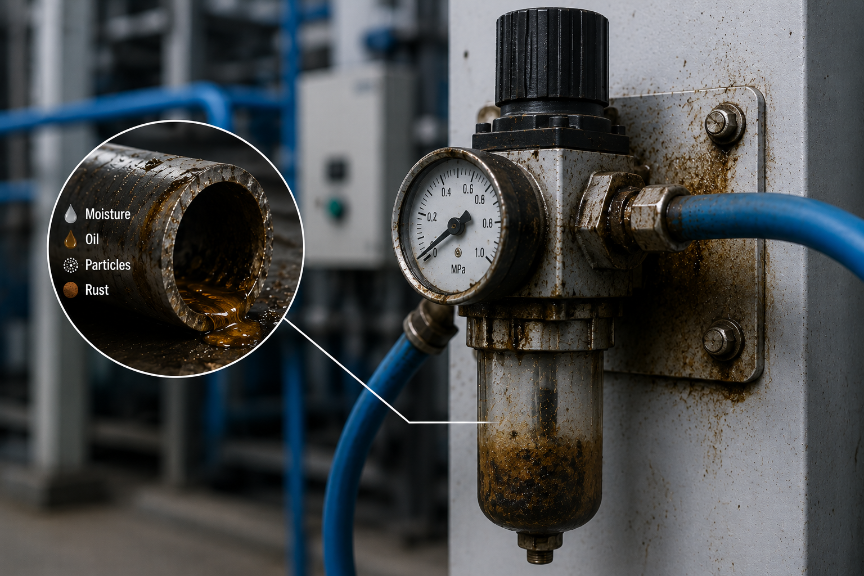
An air dryer can be running while water still reaches downstream equipment. Learn how temperature, airflow, drains and pressure dew point affect actual dryer performance.
When an air dryer is switched on and showing no alarm, it is tempting to assume that the compressed air must be dry.
Unfortunately, a running light only confirms that the machine has power. It does not prove that the dryer is achieving the required pressure dew point under current operating conditions.
If water appears downstream, the problem usually falls into one of four areas: operating conditions, condensate drainage, dryer condition or downstream temperature.
The Dryer May Be Overloaded
Compressed air dryers are rated under specific conditions. These normally include a defined:
- Inlet-air temperature
- Ambient or cooling-water temperature
- Operating pressure
- Airflow
- Required pressure dew point
Actual site conditions may be very different.
High inlet temperature places a much greater water load on the dryer. Kaeser notes that, as a rule of thumb, every 20°F increase in dryer inlet temperature may double the water load. A dryer with an adequate nameplate capacity can therefore become undersized during hot weather.
Peak airflow is another common issue. A dryer selected using average consumption may be overloaded when several machines operate at the same time.
When rated flow is exceeded, the air may pass through too quickly for the dryer to reach its specified dew point.
The Condensate Drain May Have Failed
A refrigerated dryer deliberately cools the air so that water vapor becomes liquid. That liquid must then be separated and discharged.
If the drain is blocked or defective, the dryer may continue producing condensate but fail to remove it from the air stream. Water can then be carried downstream.
Check whether the drain:
- Opens at the correct time
- Actually discharges water
- Has a clean strainer
- Has an unobstructed discharge pipe
- Is not exposed to excessive backpressure
- Closes properly after draining
A Refrigerated Dryer May Be Overheating
Refrigerated dryers need to release heat.
Dirty condenser fins, restricted ventilation or hot air recirculation can raise the refrigeration temperature and pressure dew point. Compressor rooms are often hottest when air demand is highest, creating the worst possible combination for the dryer.
Maintenance teams should inspect:
- Condenser cleanliness
- Ventilation openings
- Cooling fans
- Refrigerant condition
- Dryer inlet temperature
- Compressor-room temperature
These checks should be performed while the system is loaded, not only when production is stopped.
A Desiccant Dryer Can Also Produce Wet Air
Common desiccant-dryer problems include:
- Saturated desiccant
- Contamination by liquid water or oil
- Failed switching valves
- Incorrect regeneration cycles
- Insufficient purge flow
- Exhaust muffler restrictions
- Dew-point control faults
A desiccant dryer should not receive large quantities of liquid water. Proper upstream separation and filtration are essential because liquid contamination can damage the desiccant bed and reduce drying capacity.
The Water May Be Forming After the Dryer
A dryer can achieve its specified outlet dew point and still be unsuitable for the downstream environment.
For example, a refrigerated dryer may supply air at a +3°C pressure dew point. If part of the compressed air pipe later falls below that temperature, additional condensation can occur.
This is especially important when pipes:
- Run outdoors
- Pass through cold storage
- Enter an air-conditioned production area
- Cross an unheated building
- Experience large nighttime temperature drops
The required pressure dew point should therefore be lower than the coldest temperature the compressed air system will experience.
What Should Be Measured?
A useful investigation records:
- Maximum system airflow
- Operating pressure
- Dryer inlet temperature
- Dryer outlet pressure dew point
- Compressor-room temperature
- Lowest downstream pipe temperature
If possible, measure the pressure dew point rather than relying only on the dryer display. Comparing these values with the manufacturer’s correction factors will show whether the dryer is correctly sized for real conditions.
Water downstream of a dryer does not automatically mean the dryer is defective. It may be overloaded, unable to discharge condensate, poorly ventilated or producing a dew point that is not low enough for the distribution environment.
The correct diagnosis begins with measurements—not another filter.