
Sep 22, 2026Compressed Air Basics
Why Is There Still Water After an Air Dryer? Independent ISO 12500 Test Gives the Answer
Learn how an ISO 12500-tested compressed air precision separator removes water, particles, and oil aerosols with independently validated performance.
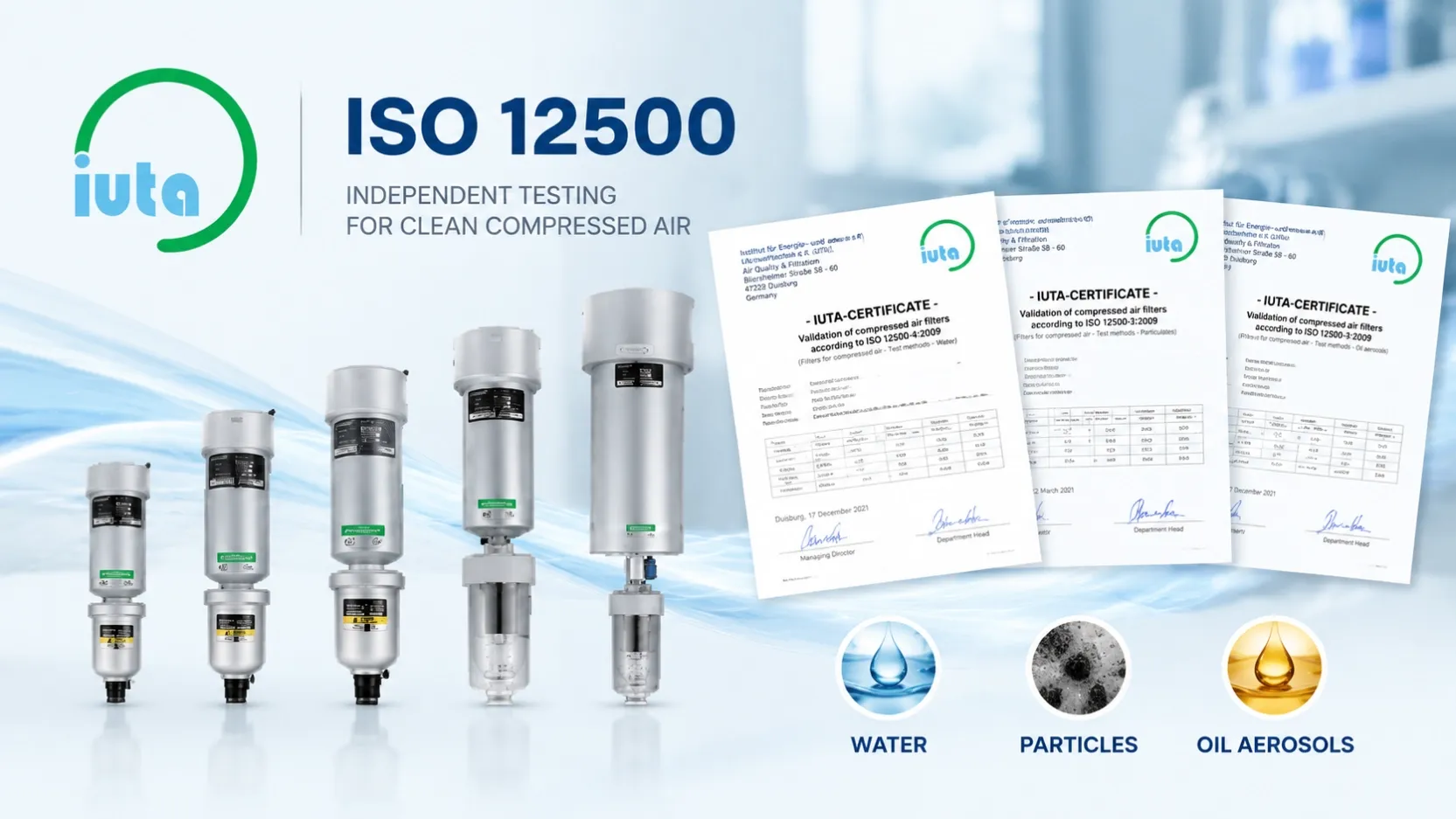
Understanding ISO 12500 Test Results
Compressed air quality directly affects the reliability of pneumatic equipment, CNC machines, robots, laser cutting systems, CMMs, and other precision manufacturing equipment.
Many suppliers claim high filtration efficiency, but how can you verify those claims?
The answer is independent testing according to internationally recognized standards.
One commonly accepted standard is ISO 12500, which evaluates compressed air filters for water, particles, and oil aerosols.
Our compressed air precision separator has been tested by an independent laboratory according to ISO 12500. The results demonstrate high removal efficiency under controlled testing conditions.
What Is ISO 12500?
ISO 12500 is an international standard for testing compressed air filters.
It consists of three main parts:
- ISO 12500-4 — Water removal efficiency
- ISO 12500-3 — Solid particle filtration
- ISO 12500-1 — Oil aerosol filtration
Rather than relying on theoretical calculations, these tests evaluate filter performance under specified operating conditions.
Water Removal Performance (ISO 12500-4)
One of the biggest problems in compressed air systems is liquid water.
Even after a refrigerated dryer, condensation can still form inside downstream piping before reaching equipment.
According to the independent test:
- Test pressure: 7 bar
- Rated flow: 48 Nm³/h
- Tested from 25% to 125% of rated flow
- Water removal efficiency remained above 99.999% across all tested flow rates.
This indicates highly effective removal of liquid water over a wide operating range.
Particle Filtration Performance (ISO 12500-3)
Compressed air often contains fine particles generated by:
- Pipe corrosion
- Compressor wear
- Dust contamination
- Rust
Independent testing measured particle removal efficiency between 0.19 μm and 2.74 μm.
Results showed:
Particle Size | Average Efficiency |
|---|---|
0.19–0.24 μm | 90.11% |
0.24–0.36 μm | 91.51% |
0.36–0.52 μm | 93.71% |
0.52–0.81 μm | 96.45% |
0.81–1.15 μm | 99% |
1.15–1.78 μm | 99.81% |
1.78–2.74 μm | 100% |
These results demonstrate increasing filtration efficiency as particle size increases.
Oil Aerosol Filtration (ISO 12500-1)
Oil aerosols may enter compressed air systems through lubricated compressors.
Testing was carried out under the following conditions:
- 7 bar inlet pressure
- 18 Sm³/h air flow
- 10 mg/m³ inlet oil concentration
- ISO VG46 compressor oil
The average filtration efficiency reached 99.996%, with a measured outlet oil concentration averaging 0.0004 mg/m³.
Why Independent Testing Matters
Independent testing provides objective performance data that helps engineers compare products using consistent methods.
Instead of relying solely on marketing claims, internationally recognized standards offer measurable performance indicators under defined laboratory conditions.
Typical Applications
A compressed air precision separator can help protect:
- CNC machining centers
- Laser cutting machines
- Coordinate Measuring Machines (CMM)
- Pneumatic cylinders
- Solenoid valves
- Industrial robots
- Automation equipment
- Air tools
By removing liquid water and reducing contamination, these systems can operate with greater reliability and lower maintenance requirements.
Conclusion
Choosing a compressed air separator is not only about flow capacity—it is also about verified performance.
Independent testing according to ISO 12500 provides measurable data for evaluating water removal, particle filtration, and oil aerosol performance.
When selecting equipment for critical compressed air applications, documented test results can provide greater confidence than performance claims alone.