
Aug 10, 2026Compressed Air Problems
Why Does a Compressed Air System Need a Water Separator?
Learn why water remains in compressed air systems, how water separators work, and when point-of-use separation is needed to protect pneumatic equipment.
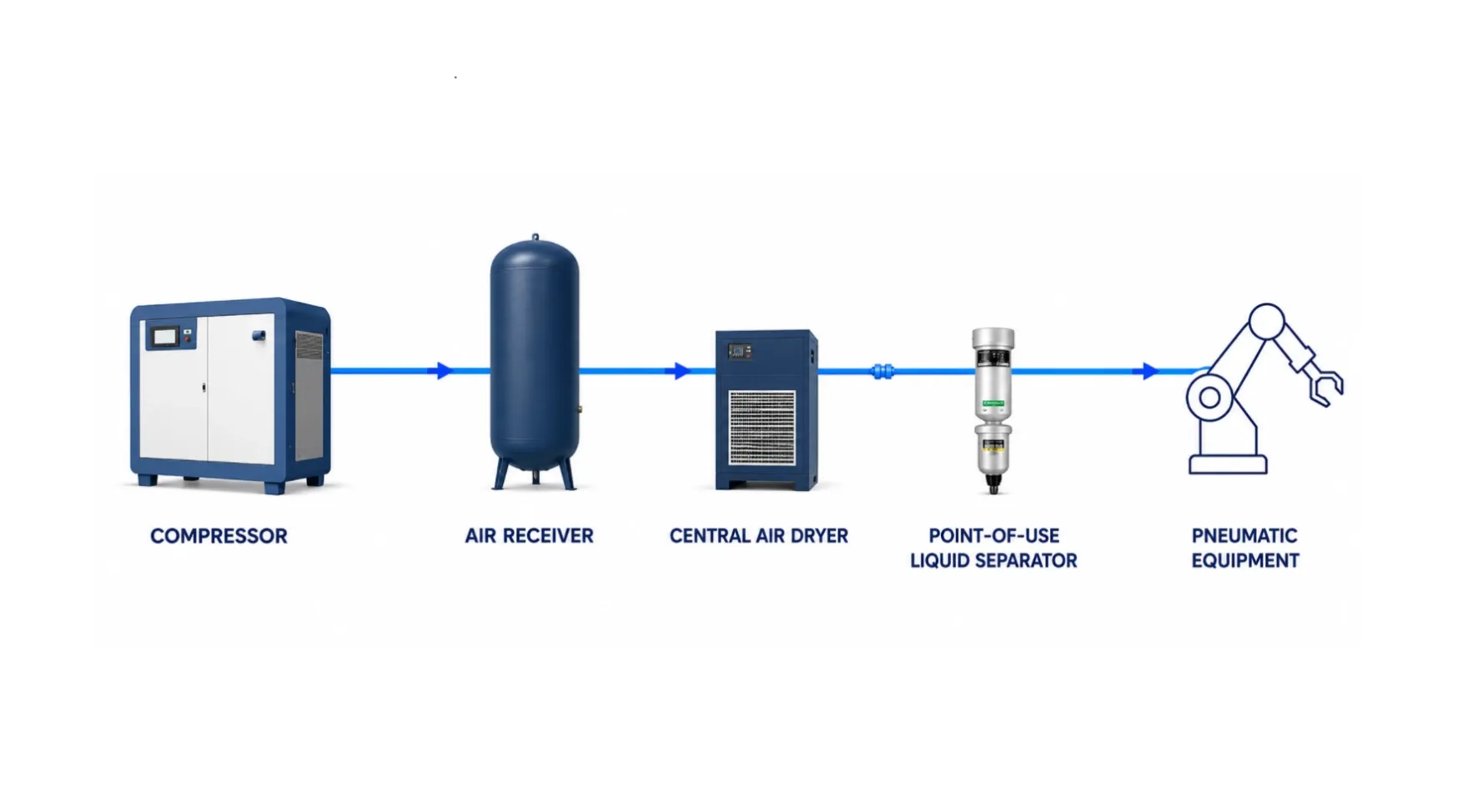
Water is one of the most common contaminants found in compressed air systems.
Even when a factory has an air dryer and central filtration system, liquid water may still appear in downstream pipelines or at the inlet of production equipment.
If this moisture is not properly removed, it can cause corrosion, unstable pneumatic operation, equipment failures and product-quality problems.
A compressed air water separator provides a simple and effective way to remove liquid water before it reaches sensitive equipment. However, selecting the right installation position is just as important as selecting the separator itself.
Why Is There Water in Compressed Air?
Atmospheric air naturally contains water vapor. When an air compressor draws in ambient air, it also draws in this moisture.
Compression raises the temperature of the air. As the compressed air passes through an aftercooler, receiver and distribution piping, it gradually cools. When its temperature falls below the pressure dew point, part of the water vapor condenses into liquid droplets.
The amount of condensate can be affected by:
- Ambient temperature and humidity
- Compressor capacity and operating hours
- Aftercooler performance
- Air dryer performance
- Pipeline length and layout
- Temperature differences across the factory
- Condition of drains and air-treatment equipment
Factories operating in hot and humid climates may experience especially high condensate loads.
What Problems Can Water Cause?
Liquid water can affect almost every part of a compressed air system.
Corrosion inside pipes and components
Moisture can cause steel pipelines, valves and other internal components to rust. Corrosion products may then travel downstream and contaminate pneumatic equipment.
Unstable pneumatic operation
Water entering cylinders, solenoid valves, regulators and pneumatic tools may cause sticking, irregular movement or premature component failure.
For CNC machines, moisture can affect pneumatic clamps, tool changers, automatic doors and air-blow systems.
Increased pressure loss
Rust, deposits and contamination can restrict airflow inside pipes and components. This creates additional pressure loss and may force the compressor to operate at a higher pressure.
Product-quality problems
Wet compressed air can create defects in painting, coating, packaging and other manufacturing processes.
In sensitive applications, moisture may also increase the risk of contamination, rejected products and rework.
Higher maintenance costs
Repeated valve failures, damaged cylinders and unplanned machine stoppages can create maintenance expenses far greater than the cost of controlling condensate correctly.
What Is a Compressed Air Water Separator?
A compressed air water separator is designed to remove liquid water droplets from compressed air.
In a centrifugal separator, compressed air enters a specially designed internal chamber and is forced into a high-speed rotating motion.
Because water droplets are heavier than air, centrifugal force moves them toward the separator wall. The droplets then fall into a collection chamber at the bottom, while the treated compressed air continues downstream.
The collected liquid must be discharged through a manual or automatic drain.
Unlike a conventional filter, a centrifugal liquid separator does not normally rely on a replaceable filter element to perform the primary separation process.
Is a Water Separator the Same as an Air Dryer?
No. A water separator and an air dryer perform different functions.
A water separator primarily removes liquid water droplets that have already condensed.
An air dryer reduces water vapor and controls the pressure dew point of the compressed air.
A separator cannot remove water vapor in the same way as a refrigerated, desiccant or membrane dryer. Similarly, a dryer may not be the most efficient component for handling a large amount of liquid water entering with the airflow.
The two products should therefore be considered complementary parts of an air-treatment system rather than direct replacements for each other.
Where Should a Water Separator Be Installed?
The correct installation position depends on the source of the moisture and the purpose of the separator.
After the air compressor and aftercooler
A central water separator can be installed after the compressor’s aftercooler to remove bulk liquid before the air enters the receiver, filters and dryer.
This reduces the condensate load on downstream air-treatment equipment.
At the point of use
A point-of-use liquid separator can be installed close to the inlet of an individual machine.
This position is useful when:
- Water still appears at the equipment despite central air treatment
- Long pipelines allow compressed air to cool and produce new condensate
- Seasonal temperature changes affect downstream air quality
- One machine requires additional protection
- Installing or upgrading a complete central dryer system is impractical
- A machine manufacturer wants to add local protection to its equipment
Point-of-use separation provides a final barrier against liquid water before compressed air enters sensitive pneumatic components.
Why Can Water Still Reach Equipment After an Air Dryer?
Installing a central air dryer does not guarantee that every machine will always receive air free from liquid water.
Residual moisture may still appear because of:
- Insufficient dryer capacity
- Poor dryer maintenance
- Changing ambient conditions
- Failed or blocked automatic drains
- Excessive pressure drop
- Air bypassing the treatment system
- Long-distance air transmission
- Additional cooling inside downstream pipelines
- Low points in the pipework where condensate accumulates
For example, compressed air leaving the dryer may travel through a long pipeline across different areas of a factory. If the air cools further during transmission, additional water vapor can condense inside the pipe.
This is why moisture problems should be investigated at the actual equipment inlet, not only inside the compressor room.
Does Every Compressed Air System Need a Water Separator?
Not every system requires the same separator configuration.
However, a water separator should be considered when visible liquid water is present, when condensate regularly reaches downstream components or when moisture-related failures occur repeatedly.
Before selecting a separator, check:
- Required airflow
- Operating pressure
- Pipe size
- Expected liquid load
- Available installation space
- Direction of airflow
- Drainage method
- Acceptable pressure drop
- Location of the moisture problem
A correctly sized separator should handle the required airflow without creating excessive pressure loss.
A Complete Moisture-Control Strategy
Reliable compressed air treatment normally requires several components working together:
- Aftercoolers condense part of the water vapor
- Central separators remove bulk liquid water
- Air dryers reduce water vapor and control dew point
- Filters remove oil aerosols and fine particulates
- Point-of-use separators provide final protection at critical machines
No single component can solve every compressed air quality problem.
The most effective approach is to identify where the moisture forms, determine whether it is vapor or liquid and install the appropriate treatment equipment at the correct position.
Final Protection for Sensitive Equipment
When residual liquid water continues to reach CNC machines, automation systems or other pneumatic equipment, point-of-use separation can provide an additional level of protection.
ENHUI point-of-use compressed air liquid separators are installed close to the equipment inlet to remove liquid water, oil droplets and particulates before they reach sensitive pneumatic components.
They require no electricity or conventional filter-element replacement and can be integrated into existing compressed air systems with minimal maintenance.
A point-of-use separator is not intended to replace a properly selected central air dryer. It is designed to provide final-stage protection where residual liquid contamination remains a problem.
If you are unsure which model or installation position is suitable for your equipment, contact ENHUI with your airflow, pressure, pipe size and application information.