
Sep 14, 2026Compressed Air Problems
Why Clean Compressed Air Matters for Pneumatic Equipment
Learn why liquid water can still appear at machine inlets after an air dryer, how compressed air contaminants are treated, and how a point-of-use precision separator helps protect pneumatic equipment.
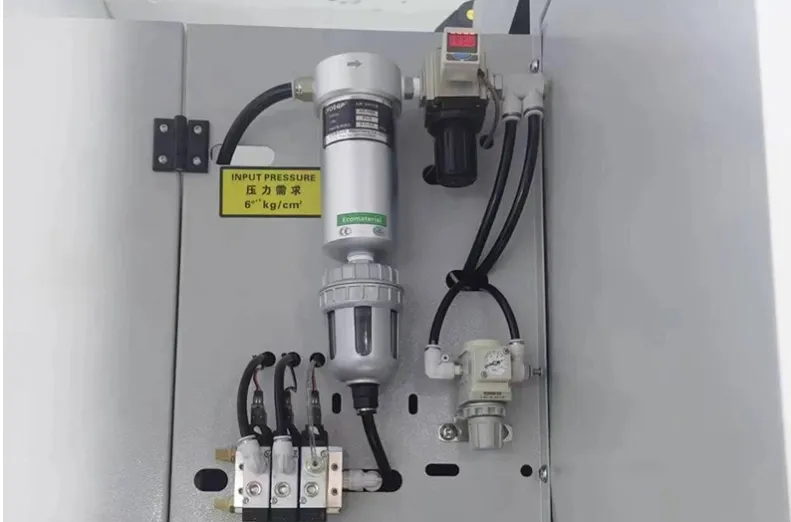
Compressed air is widely used in CNC machines, automation systems, pneumatic cylinders, valves, robotic equipment and industrial production lines. However, air coming directly from a compressor is rarely clean enough for sensitive downstream equipment.
It may contain:
- Liquid water
- Water vapor
- Solid particles
- Oil droplets and aerosols
- Rust and pipe contamination
If these contaminants reach pneumatic components, they can contribute to valve sticking, unstable cylinder movement, corrosion, premature seal wear and unexpected machine downtime.
That is why proper compressed air treatment is essential for reliable pneumatic systems.
Where Does Water in Compressed Air Come From?
Ambient air naturally contains moisture. During compression, the concentration of water vapor increases.
The compressed air leaving the compressor is also hot. As it cools in:
- Aftercoolers
- Air receivers
- Main pipelines
- Branch lines
- Machine-side piping
water vapor can condense into liquid water.
This is an important point: water can continue to form downstream, even after the air has already passed through central air-treatment equipment.
For this reason, good compressed air system design normally includes drainage points and air-treatment equipment at appropriate locations throughout the system. Pneumatic Tips also notes that because compressed air can continue cooling as it moves through distribution and branch lines, treatment close to the actual point of use can be more effective than relying only on centralized filtration.
Why Can Water Still Appear After an Air Dryer?
This is one of the most common questions in compressed air systems.
A dryer primarily reduces water vapor by lowering the pressure dew point. It does not necessarily guarantee that no liquid water will ever appear at the machine inlet.
Liquid condensate may still occur because of:
- Long piping distances
- Temperature changes between the compressor room and production area
- Poor pipe drainage
- Low points in the piping system
- Seasonal temperature changes
- Condensate carried over from upstream equipment
If the compressed air temperature later drops below its dew point, remaining moisture can condense again.
Therefore:
Dry air at the compressor room does not always mean liquid-free air at the machine inlet.
This is especially relevant for long compressed-air networks and equipment located far from the central dryer.
Liquid Water and Water Vapor Are Different Problems
It is useful to separate these two issues.
Water vapor
Water vapor is moisture in gaseous form.
To reduce it, compressed air systems normally use dryers such as:
- Refrigerated dryers
- Desiccant dryers
- Other specialized drying systems
These systems are selected according to the required pressure dew point.
Liquid water
Liquid water is condensed moisture already present inside the pipeline.
It may be removed through:
- Drain legs
- Automatic drains
- Water separators
- Filters
- Point-of-use liquid separators
The original Pneumatic Tips article makes the same distinction: properly removing liquid water does not necessarily remove water vapor, while dryers are used when the vapor content must be reduced to prevent later condensation.
This distinction is important when troubleshooting moisture problems.
What About Solid Particles?
Water is not the only contaminant.
Compressed air systems can also contain particles originating from:
- Ambient air
- Pipe corrosion
- Rust
- Compressor deposits
- Carbon build-up
General-purpose filters can remove larger particles, while sensitive applications may require finer filtration.
Examples include:
- Precision automation
- Instrumentation
- Spray painting
- Electronics
- Food processing
- Measurement equipment
The finer the required air quality, the more important it becomes to select the correct filter grade and protect fine filters from excessive upstream contamination.
Oil Contamination Also Requires Different Treatment
Oil from lubricated compressors can enter the compressed air system in several forms:
- Liquid oil
- Oil-water emulsions
- Fine oil aerosols
- Oil vapor
These contaminants cannot all be removed by the same device.
General filters or separators can handle larger liquid contamination, while very fine oil aerosols normally require coalescing filters. Oil vapor may require activated-carbon adsorption in applications with stricter air-quality requirements.
This is why compressed air treatment should be considered as a system, rather than expecting one component to remove every contaminant.
Why Point-of-Use Liquid Separation Matters
Central dryers and filters are important, but they are located upstream.
Between the compressor room and the machine, compressed air may travel through tens or hundreds of meters of piping. During this journey, temperature and operating conditions can change.
That means liquid condensate can appear again near the equipment.
Installing a point-of-use compressed air precision separator close to the machine provides an additional layer of protection against this residual liquid contamination.
A typical arrangement may be:
Compressor → Aftercooler → Air Receiver → Dryer → Main Filter → Distribution Pipe → Precision Air Separator → FRL / Regulator → Machine
The exact arrangement depends on the application and required air quality.
ENHUI Point-of-Use Compressed Air Precision Separator
ENHUI TECH provides point-of-use compressed air precision separators designed to remove liquid condensate before compressed air enters critical equipment.
The separator is particularly suitable for applications where liquid moisture continues to appear downstream despite centralized drying and filtration.
Typical applications include:
- CNC machines
- Machine tools
- Automation equipment
- Pneumatic valves and cylinders
- Robotic systems
- Laser equipment
- Spray systems
- Precision manufacturing equipment
Key Advantages
No electricity required
The separator operates without electrical power, making installation simple and suitable for machine-side use.
No replaceable filter element
Unlike conventional filter-element-based solutions, there is no routine filter cartridge replacement for liquid separation.
Low maintenance
The design minimizes routine maintenance and reduces dependence on consumables.
Automatic condensate drainage
The separated liquid can be discharged automatically when equipped with an automatic drain.
Low pressure drop
The separator is designed for compressed-air applications where maintaining airflow and equipment performance is important.
Compact point-of-use installation
It can be installed close to CNC machines, pneumatic systems or production equipment where liquid condensate needs to be removed before entering sensitive components.
Does a Precision Air Separator Replace a Filter or FRL?
Not necessarily.
A precision air separator and an FRL or fine filter perform different functions.
A point-of-use separator is primarily intended to remove liquid condensate and liquid droplets.
A conventional filter may still be required when the application has specific requirements for:
- Fine particle filtration
- Oil aerosol removal
- Very high air-purity classes
A regulator is also still required when downstream pressure must be controlled.
Therefore, the separator should often be viewed as:
additional liquid-condensate protection rather than a universal replacement for every air-treatment component.
For example:
For standard CNC or automation applications:
Precision Air Separator → Regulator → Machine
may be sufficient when the upstream system already provides acceptable particulate filtration.
For applications requiring higher air purity:
Precision Air Separator → Fine Filter / Coalescing Filter → Regulator → Equipment
may be more appropriate.
Where Should a Point-of-Use Separator Be Installed?
For liquid condensate control, installation location matters.
The separator is normally most useful:
- Near the machine inlet
- Before sensitive pneumatic valves and cylinders
- After long distribution pipelines
- At locations where condensate repeatedly appears
- Before fine filters when reducing liquid load on downstream filtration is desirable
This follows the broader compressed-air design principle that liquid water should be removed where it actually accumulates and where it can be effectively drained.
Signs Your Equipment May Need Additional Point-of-Use Water Separation
You may want to investigate additional liquid separation if you experience:
- Water repeatedly appearing in machine-side filter bowls
- Frequent draining at equipment inlets
- Valve sticking
- Unstable cylinder movement
- Moisture-related machine alarms
- Corrosion in pneumatic components
- Frequent filter-element replacement
- Water appearing despite having a central dryer
- Compressed-air lines running through areas with large temperature changes
In these situations, the problem may not simply be “the dryer is not working.”
The actual issue may be condensation occurring downstream of the dryer.
Choose Air Treatment According to the Actual Contaminant
Good compressed air treatment starts by identifying the real problem.
If the problem is:
Water vapor → use an appropriate dryer
Liquid condensate → use drainage and liquid separation
Solid particles → use particulate filtration
Oil aerosol → use coalescing filtration
Oil vapor → use adsorption treatment where required
Many reliable pneumatic systems combine several of these technologies.
The goal is not to use the largest number of components possible. It is to install the right treatment device in the right location.
Still Finding Water at Your Machine Inlet?
If your CNC machine, automation system or pneumatic equipment still receives liquid water after the compressed air has passed through a dryer and main filtration system, the moisture may be forming further downstream.
ENHUI TECH provides point-of-use compressed air precision separators designed for machine-side liquid condensate removal.
We can help you evaluate:
- Your compressed air flow rate
- Pipe size
- Working pressure
- Existing dryer and filter arrangement
- Installation location
- Equipment application