
Jul 22, 2026Compressed Air Problems
What Are the Main Components of a Compressed Air Treatment System?
Compressed air treatment removes water, oil, and particles through filters, dryers, separators, and point-of-use protection, helping deliver cleaner air and protect equipment reliability.
Components of a Compressed Air Treatment System: From Contaminated Air to Clean Air Supply
Compressed air is often called the “fourth utility” in industrial production, but the air delivered directly from an air compressor is not naturally clean.
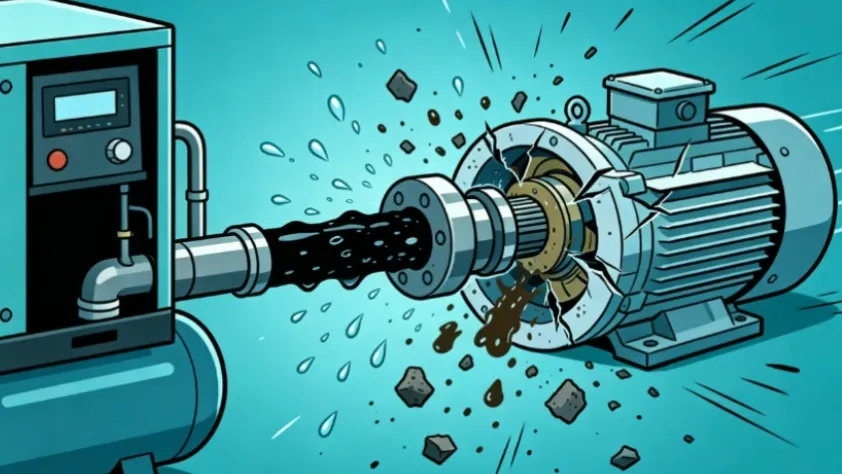
During compression, air may carry water vapor, liquid water, oil mist, dust, metal particles, and other contaminants. If these impurities enter pneumatic tools, valves, cylinders, spraying equipment, measuring instruments, or automated machines, they may cause corrosion, unstable operation, product defects, and unexpected downtime.
A compressed air treatment system is designed to remove these contaminants step by step. Instead of relying on one single device, it usually combines several treatment modules, each serving a different function. The right configuration depends on the compressor type, air quality requirements, production environment, and the sensitivity of downstream equipment.
Below are five core modules commonly used in compressed air treatment systems.
1. Pre-Filter: The First Protection for Downstream Equipment
Main Function
The pre-filter is usually installed after the air compressor or air receiver. It acts as the first line of protection by removing larger solid particles, liquid water, and part of the oil droplets from compressed air.
Its main purpose is not to provide final air quality, but to protect downstream equipment such as dryers, precision filters, valves, and pipelines from blockage, contamination, and premature wear.
How It Works
A pre-filter usually works through mechanical separation and filtration. When compressed air enters the filter housing, heavier particles and liquid droplets are separated by changes in airflow direction, centrifugal force, or impact against internal surfaces.
The separated liquid water and oil collect at the bottom of the filter bowl and are discharged through a manual or automatic drain valve.
Selection and Maintenance Notes
When selecting a pre-filter, the airflow capacity should match the compressor output and system pressure. The filter element should also be suitable for the working temperature and oil content of the compressed air system.
Regular maintenance is important. A blocked filter element increases pressure drop, which can reduce system efficiency and increase compressor energy consumption. The drain should also be checked regularly to prevent liquid water from accumulating inside the filter.
2. Air Dryer: Removing Water Vapor and Reducing Condensation Risk
Main Function
Moisture is one of the most common problems in compressed air systems. Even if liquid water is removed by separators and filters, water vapor may still remain in the air. When the temperature drops, this vapor can condense inside pipelines and equipment.
This can lead to pipe corrosion, rust inside pneumatic components, valve sticking, cylinder failure, unstable machine operation, and quality problems in processes such as spraying, packaging, electronics, and precision manufacturing.
An air dryer is used to reduce the moisture content of compressed air by lowering its dew point.
Common Types of Air Dryers
Refrigerated Air Dryer
A refrigerated air dryer cools compressed air so that water vapor condenses into liquid water. The condensed water is then separated and discharged.
This type of dryer is widely used in general industrial applications because it is relatively economical, easy to maintain, and suitable for many standard factory air systems.
It is commonly used for:
- General factory compressed air supply
- Pneumatic tools
- Standard production lines
- General machinery and equipment
However, refrigerated dryers are usually not suitable for applications that require extremely low dew points.
Desiccant Air Dryer
A desiccant dryer uses adsorbent materials such as activated alumina, silica gel, or molecular sieve to absorb water vapor from compressed air.
It can achieve much lower dew points than refrigerated dryers, making it suitable for applications where very dry air is required.
It is commonly used for:
- Electronics manufacturing
- Pharmaceutical production
- Food processing
- Precision instruments
- Low dew point applications
The advantage of a desiccant dryer is deeper drying performance. The trade-off is higher cost, more complex maintenance, and in some designs, the use of compressed air for regeneration.
Selection Notes
The dryer should be selected according to the required dew point, working pressure, inlet temperature, ambient temperature, and airflow capacity.
A dryer that is too small may become overloaded, especially in hot and humid environments. A dryer that is too large may increase unnecessary investment cost. In practice, the dryer capacity is often selected with a certain safety margin above the compressor output.
3. Precision Filter: Removing Fine Particles and Oil Mist
Main Function
After pre-filtration and drying, compressed air may still contain fine particles and small oil mist. These contaminants can be too small to be removed by standard filters, but they may still affect sensitive equipment and production quality.
Precision filters are used to further improve air cleanliness. They are especially important for applications such as spraying, printing, pneumatic control systems, automation equipment, measuring devices, food packaging, and electronics manufacturing.
How It Works
Precision filters usually use multi-layer filter elements made from glass fiber, synthetic fiber, or membrane materials. As compressed air passes through the filter element, fine particles and oil mist are captured by interception, coalescence, and adsorption.
Oil mist droplets may gather into larger droplets and then drain to the bottom of the filter housing.
Common Filter Grades
Different grades of filters are used depending on the required air quality:
General coalescing filter
Used to remove larger oil mist and particles. It is often installed before higher-efficiency filters.
Fine coalescing filter
Used to remove smaller oil mist and fine particles. It is suitable for pneumatic tools, cylinders, and general industrial equipment.
High-efficiency filter
Used for applications that require cleaner air, such as spraying, printing, and precision pneumatic systems.
Activated carbon filter
Used to remove oil vapor and odor. It is often used in food, pharmaceutical, electronics, and other applications where air quality is more sensitive.
Maintenance Notes
Filter elements should be replaced regularly based on operating hours, pressure drop, oil content, and the production environment. A filter that is not replaced in time may become a source of pressure loss or secondary contamination.
4. Oil-Air Separator: Reducing Oil Carryover from Oil-Lubricated Compressors
Main Function
In oil-lubricated screw compressors and piston compressors, lubricating oil is used for cooling, sealing, and lubrication. During compression, part of the oil may be carried into the compressed air stream.
The oil-air separator is designed to separate most of this lubricating oil before the air enters the downstream treatment system.
Its main functions are:
- Reduce oil carryover from the compressor
- Protect dryers and filters from oil contamination
- Reduce oil consumption
- Help maintain stable compressor operation
For oil-free compressors, this module may not be required in the same way, but downstream filtration may still be needed depending on the air quality requirement.
How It Works
The oil-air separator typically uses centrifugal separation and coalescing filtration. Larger oil droplets are separated by airflow direction changes and centrifugal force, while smaller oil mist particles are captured by the separator element.
The separated oil is returned to the compressor oil circuit through an oil return line.
Maintenance Notes
The separator element should be replaced according to compressor maintenance requirements. A blocked separator can cause high pressure drop, increased energy consumption, and compressor faults.
The oil return line should also be checked to ensure that separated oil can return properly.
5. Final Filter and Point-of-Use Protection: Air Quality at the Equipment Side
Main Function
Even after central air treatment, compressed air quality may still change during transmission. Long pipelines, old branch lines, temperature changes, and local pressure drops can cause moisture, rust particles, or oil residues to appear again near the equipment side.
For this reason, many systems use final filtration or point-of-use protection close to the machine inlet. This is especially useful when only certain machines require higher air quality, or when the central system cannot fully prevent moisture from appearing at the end of the line.
Common Final Treatment Options
Sterile Filter
A sterile filter is used in food, beverage, pharmaceutical, and biotechnology applications. It helps remove microorganisms and fine particles before compressed air contacts products or packaging areas.
Ultra-Clean Filter
Ultra-clean filters are used in applications such as electronics, semiconductors, precision instruments, and cleanroom-related processes. They help control fine particles and maintain stable air cleanliness.
Activated Carbon Filter
Activated carbon filters are used to remove oil vapor, odor, and certain gaseous contaminants. They are suitable for applications where air odor or vapor contamination may affect product quality.
Point-of-Use Compressed Air Dryer
A point-of-use compressed air dryer is installed close to the machine or equipment air inlet. Its role is different from a central refrigerated or desiccant dryer. Instead of treating the entire compressed air system, it provides local moisture protection at the point where the air is actually used.
This type of device can be useful for equipment-side applications such as:
- CNC machines
- Automation equipment
- Pneumatic valves and cylinders
- Packaging machines
- Air blowing points
- Branch air lines
- Equipment with moisture-sensitive pneumatic components
In many systems, a point-of-use dryer is not intended to replace the central air dryer. Instead, it works as an additional layer of protection when moisture may still appear near the machine side due to pipeline condensation, long-distance transmission, or unstable operating conditions.
For factories that do not need ultra-dry air everywhere, point-of-use treatment can also help avoid over-treating the entire compressed air system. It allows higher air quality to be provided only where it is actually needed.
Selection Notes
Final treatment devices should be selected according to the actual equipment requirement. For example, food and pharmaceutical applications may require sterile filtration, while CNC machines and automation equipment may benefit more from local moisture protection and stable air supply.
The key is to match the final treatment method with the real risk at the point of use.
Typical Compressed Air Treatment Configurations
Different industries and applications require different levels of air treatment. A practical system is usually built by combining several modules.
1. General Industrial Applications
Typical configuration:
Air compressor → Oil-air separator → Pre-filter → Refrigerated air dryer → Precision filter
Suitable for:
- General machinery
- Repair shops
- Pneumatic tools
- Standard factory air supply
- Metalworking and general manufacturing
This configuration focuses on removing liquid water, larger particles, and general oil mist.
2. Spraying and Printing Applications
Typical configuration:
Air compressor → Oil-air separator → Pre-filter → Refrigerated air dryer → High-efficiency precision filter → Activated carbon filter
Suitable for:
- Spray painting
- Printing equipment
- Surface finishing
- Coating processes
These applications are sensitive to oil mist, water, and odor. Poor air quality may cause defects such as oil spots, poor adhesion, uneven coating, or surface contamination.
3. Electronics, Food, and Pharmaceutical Applications
Typical configuration:
Air compressor → Oil-air separator → Pre-filter → Desiccant air dryer → High-efficiency precision filter → Sterile or ultra-clean final filter
Suitable for:
- Electronics manufacturing
- Pharmaceutical production
- Food packaging
- Precision instruments
- Clean air applications
These systems often require lower dew points, finer filtration, and stricter contamination control.
4. Equipment-Side Moisture Protection
Typical configuration:
Central compressed air system → Main dryer and filters → Branch pipeline → Point-of-use dryer or final filter near the machine inlet
Suitable for:
- CNC machines
- Automated production lines
- Pneumatic control cabinets
- Packaging machines
- Local air-use points far from the compressor room
This configuration is useful when the central air treatment system is already in place, but moisture still appears near certain machines due to pipeline condensation or local working conditions.
Building a Compressed Air Treatment System: The Key Is Proper Matching
A compressed air treatment system is not a fixed combination of equipment. It should be designed according to the actual production process and air quality requirement.
Before selecting equipment, it is important to clarify:
- Is the compressor oil-lubricated or oil-free?
- What dew point is required?
- What particle size and oil content limits are needed?
- Is the application general, precision, food-grade, or sterile?
- Are there long pipelines or branch lines that may cause condensation?
- Do all machines need the same air quality, or only certain points?
A good design usually follows the logic of removing larger contaminants first, then moisture, then fine particles and oil mist, and finally applying point-of-use protection where needed.
Over-treatment may increase cost and pressure drop. Under-treatment may lead to equipment failure, unstable production, and quality problems.
The goal is not simply to make the air “as dry as possible” everywhere. The better goal is to deliver the right air quality to the right point of use.
When each module is properly selected and maintained, compressed air can become a stable, clean, and reliable power source for industrial production.