
Aug 20, 2026Compressed Air Problems
Refrigerated Dryer vs. Desiccant Dryer vs. Point-of-Use Water Separator
Compare refrigerated dryers, desiccant dryers and point-of-use water separators by dew point, operating cost, maintenance and application.
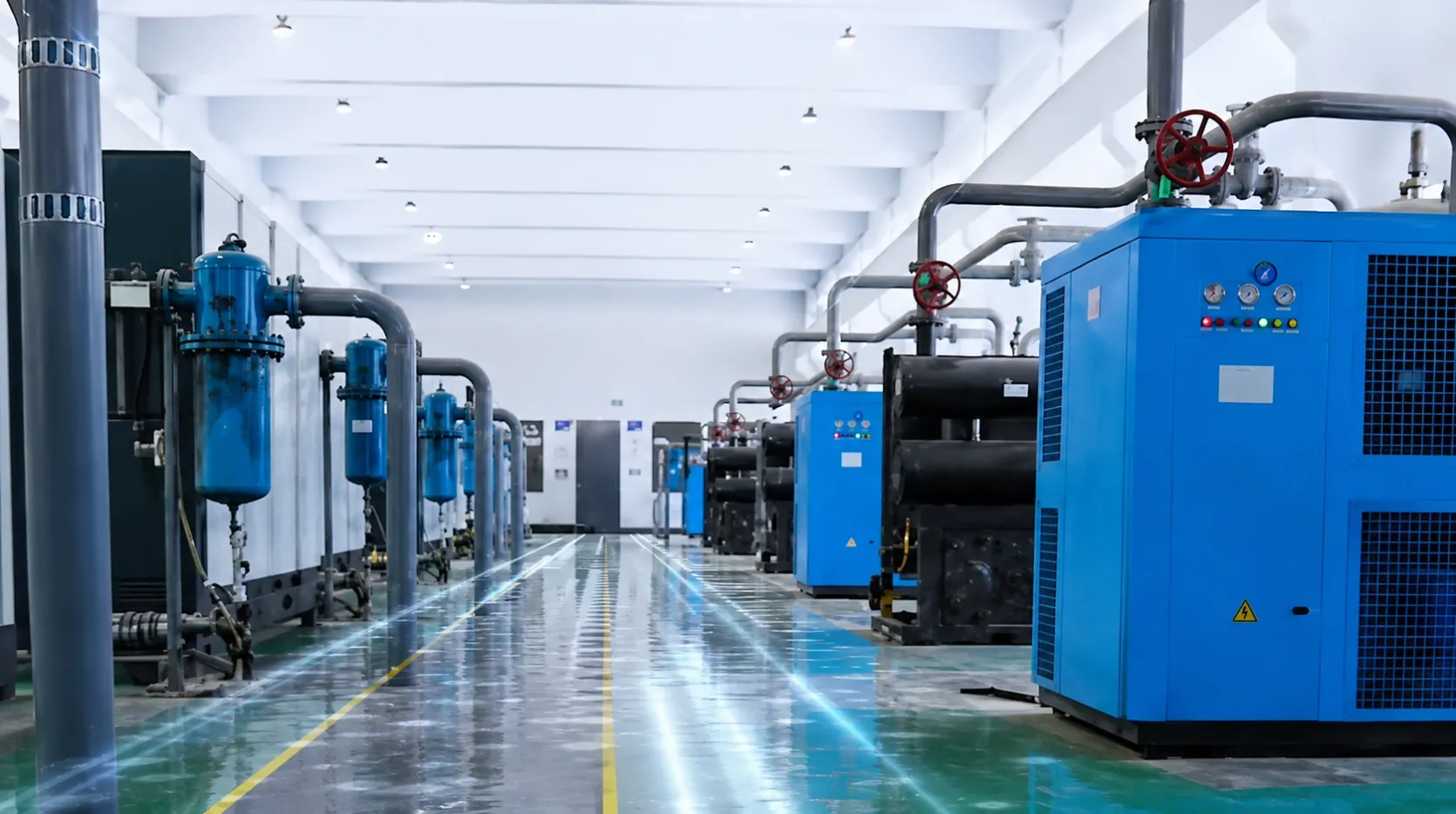
Compare refrigerated dryers, desiccant dryers and point-of-use water separators by dew point, cost, maintenance and application.
Moisture-control equipment does not all perform the same job.
A refrigerated dryer, desiccant dryer and point-of-use water separator may all reduce visible moisture problems, but they operate differently. Selecting the wrong device can leave water vapor in the system or create unnecessary operating costs.
The first step is understanding whether the problem is liquid water, water aerosol or water vapor.
Start With Pressure Dew Point
Pressure dew point, or PDP, is the temperature at which water vapor begins to condense while the air remains at system pressure.
A lower PDP means drier compressed air.
Refrigerated and desiccant dryers remove water vapor and reduce the PDP. A point-of-use water separator only removes liquid droplets present at its installation point. It does not change the PDP.
This is the most important difference between the three options.
Refrigerated Air Dryers
A refrigerated dryer cools the compressed air under controlled conditions. This causes water vapor to condense into liquid, which is then separated and discharged.
Typical pressure dew point:
Approximately +3°C to +7°C
Common applications include:
- Pneumatic tools
- General manufacturing
- Indoor assembly lines
- Workshops
- Packaging equipment
- Non-critical process air
Advantages
- Suitable for most indoor industrial applications
- Lower initial cost than many desiccant systems
- Relatively low energy consumption
- Consistent dew-point performance when correctly sized
- Little or no compressed-air purge loss
Limitations
A refrigerated dryer normally delivers a positive PDP. If downstream piping becomes colder than the dryer’s pressure dew point, additional condensation may form.
It is generally unsuitable when compressed air piping is exposed to freezing conditions.
Desiccant Air Dryers
A desiccant dryer passes compressed air through a material that attracts and holds water-vapor molecules. Twin-tower systems use one tower for drying while the other is regenerated.
A common industrial pressure dew point is:
Approximately −40°C
Lower dew points are available for specialized applications.
Common uses include:
- Instrument air
- Outdoor compressed air piping
- Sub-freezing environments
- Critical pneumatic controls
- Electronics manufacturing
- Moisture-sensitive production
Advantages
- Produces much drier compressed air
- Suitable for freezing conditions
- Protects sensitive instruments and processes
- Can achieve very low pressure dew points
Limitations
- Higher purchase and operating costs
- Some designs consume compressed purge air
- More valves and control components to maintain
- Desiccant requires periodic inspection or replacement
- Liquid water and oil contamination can damage the desiccant bed
Effective upstream separation and filtration are therefore essential.
Point-of-Use Water Separators
A point-of-use water separator is installed near an individual machine, tool, paint booth or production process.
It changes the direction or velocity of the airflow so that liquid droplets are separated and collected in a bowl. Some units include a particulate filter or coalescing element.
Common applications include:
- Spray guns
- Plasma cutters
- Pneumatic tools
- Air-operated machines
- Temporary workstations
- Additional protection for sensitive equipment
Advantages
- Low initial cost
- Simple installation
- Easy visual inspection
- Removes liquid close to the equipment
- Useful as a final safeguard
- Can protect one critical user without modifying the entire system
Limitations
A point-of-use separator does not remove water vapor or reduce pressure dew point.
If the incoming air is warm and still contains a high vapor load, the moisture may pass through the separator and condense later in the hose or equipment.
Its performance also depends on:
- Air velocity
- Droplet size
- Flow direction
- Drain condition
- Bowl capacity
- Installation position
A point-of-use separator should therefore not be expected to dry an entire compressed air supply.
Direct Comparison
Consideration | Refrigerated dryer | Desiccant dryer | Point-of-use separator |
|---|---|---|---|
Removes bulk liquid | Yes, through internal separation | Requires upstream separation | Yes |
Removes water vapor | Yes | Yes | No |
Reduces pressure dew point | Yes | Yes | No |
Typical PDP | +3°C to +7°C | Around −40°C | No PDP reduction |
Protects entire system | Yes | Yes | No, local protection only |
Suitable for indoor tools | Usually | Usually unnecessary | Useful as final protection |
Suitable for freezing pipes | Usually not | Yes | No |
Initial cost | Medium | Higher | Low |
Operating cost | Generally moderate | Generally higher | Low |
Maintenance focus | Condenser, refrigeration circuit and drains | Filters, valves, drains and desiccant | Filter element, bowl and drain |
Best role | Main dryer for general industrial air | Main dryer for critical or cold applications | Final liquid-removal stage |
Can a Point-of-Use Separator Replace a Dryer?
Sometimes a small workshop only experiences occasional liquid carryover. If the compressor is used intermittently and the application is not moisture-sensitive, a point-of-use separator may provide an acceptable practical improvement.
However, it is not a technical replacement for a dryer.
A separator may be insufficient when:
- Water repeatedly fills the separator bowl
- Moisture appears in several areas
- The plant operates in hot and humid conditions
- Air pipes pass through colder spaces
- Paint finish or product quality is affected
- Plasma consumables experience premature wear
- Pneumatic controls require reliable dry air
Frequent water accumulation at the point of use is usually a reason to investigate the main air-treatment system.
A Combined Approach
For paint spraying, plasma cutting and other sensitive processes, the most reliable arrangement is often:
Main refrigerated or desiccant dryer → distribution piping → point-of-use separator or coalescing filter
The central dryer controls water vapor and pressure dew point. The point-of-use device then captures residual liquid, aerosols and particles close to the equipment.
A small disposable desiccant cartridge may provide additional final drying for intermittent use, but it can become saturated quickly if the main air supply is wet.
How to Choose
Choose a refrigerated dryer when:
- The piping remains indoors
- Temperatures stay above the dryer PDP
- General industrial air quality is sufficient
- Energy efficiency is important
Choose a desiccant dryer when:
- Piping may experience freezing temperatures
- The process requires very dry air
- Instrument or control air must be protected
- Moisture-related failure would be costly
Choose a point-of-use separator when:
- Liquid protection is needed at one machine
- The main compressed air is already reasonably dry
- An additional safety stage is required
- Air usage is intermittent and non-critical
Atlas Copco identifies refrigerated dryers as the common solution for general industrial applications, while colder and more moisture-sensitive conditions usually require desiccant drying. Atlas Copco dryer selection guide
The right question is not simply, “Which device removes water?”
It is:
Do we need to remove liquid at one location, or control water vapor throughout the entire compressed air system?