
Jun 30, 2026Compressed Air Problems
Is Your Compressed Air Dryer Quietly Wasting Energy?
Compressed air dryers affect more than moisture removal. Learn how dryer type, pressure drop, maintenance, and point-of-use drying can influence energy efficiency and equipment reliability.
Compressed air is one of the most important utilities in modern factories. It powers pneumatic tools, automation equipment, CNC machines, packaging lines, valves, cylinders, and many other industrial devices.
When companies talk about compressed air energy savings, they often focus first on the air compressor.
This makes sense. Compressors consume a lot of energy.
But there is another part of the system that should not be ignored:
The compressed air dryer.
A dryer is not only responsible for removing moisture. It can also affect pressure drop, maintenance cost, air loss, and overall system efficiency.
Choosing the wrong dryer, or using the right dryer in the wrong place, can quietly increase operating cost over time.
Different Dryers Have Different Energy Characteristics
There are several common types of compressed air dryers. Each type has its own advantages, limitations, and energy behavior.
Refrigerated Air Dryers
Refrigerated dryers are widely used in general industrial compressed air systems.
They work by cooling compressed air so that water vapor condenses into liquid water. The condensate is then separated and drained from the system.
This type of dryer is common, reliable, and suitable for many general applications.
However, not all refrigerated dryers operate in the same way.
A non-cycling refrigerated dryer may continue running at full power even when air demand is low. For factories where air demand drops during evenings, weekends, or low-production periods, this may lead to unnecessary energy use.
A cycling refrigerated dryer can reduce energy consumption during lower-load periods by adjusting operation according to demand.
This shows an important point:
Even when the air is dry, the system may not be operating efficiently.
Desiccant Dryers: Very Dry Air, But Sometimes Higher Cost
Desiccant dryers are used when compressed air needs to be much drier than what a standard refrigerated dryer can provide.
Instead of cooling the air, desiccant dryers use moisture-absorbing material to remove water vapor.
They are often used when a very low dew point is required, such as instrument air, precision equipment, cold environments, or sensitive production processes.
Desiccant dryers can be effective, but some types may consume compressed air during regeneration.
For example, heatless desiccant dryers use a portion of dry compressed air to regenerate the desiccant material. This purge air does not go to production. It is used by the dryer itself.
In some systems, this can represent a noticeable operating cost.
Heated desiccant dryers and heat-of-compression dryers can reduce this loss in certain applications, but they also require correct system design and suitable operating conditions.
This is why dryer selection should be based on the real air quality requirement of each application.
Do You Need the Driest Air Everywhere?
One common mistake is assuming that the entire factory needs the same air quality level.
In reality, different applications may have different requirements.
Some equipment may only need general dry compressed air.
Some sensitive machines may need extra moisture protection.
Some branch lines may have condensation problems due to long piping or temperature changes.
Some machine inlets may require local protection because water appears near the point of use.
Using one large system to provide very dry air everywhere may not always be the most efficient solution.
A better approach is to ask:
Where is dry air really needed?
This helps factories avoid over-treatment in areas that do not require it, while still protecting critical equipment where air quality matters most.
Why Point-of-Use Drying Can Be Useful
Even if a central dryer is installed, moisture problems may still appear at the equipment side.
This can happen because compressed air travels through long pipelines, branch lines, storage tanks, valves, and fittings before reaching the machine.
During this process:
- Air temperature may drop
- Condensate may form again
- Drain valves may fail
- Rust or particles may enter from older pipelines
- Some machines may require better air quality than the general line
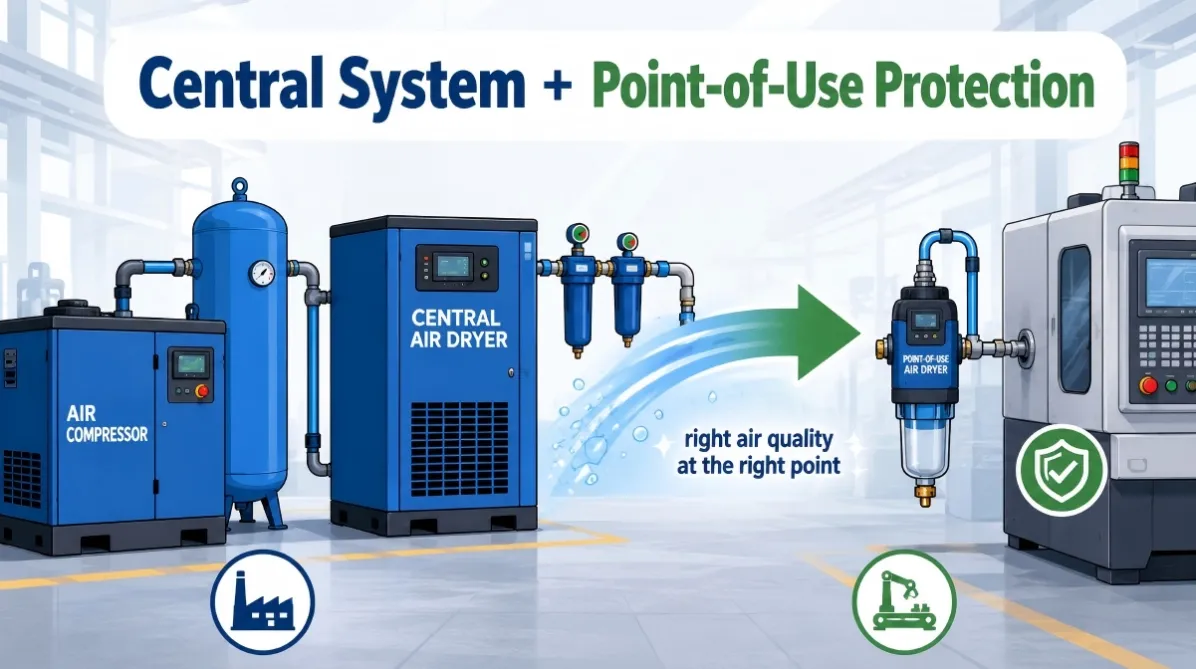
A point-of-use air dryer is installed close to the machine inlet or local branch line. It helps remove moisture before compressed air enters the equipment.
This makes it useful for:
- CNC machines
- Automation equipment
- Pneumatic valves
- Cylinders
- Packaging machines
- Machine tool air inlets
- Local branch lines
- Equipment with repeated moisture problems
Point-of-use drying is not always a replacement for central dryers. In many cases, it works as an additional layer of protection.
However, in some distributed air systems, multiple point-of-use dryers may also be used on branch lines to provide local moisture control instead of relying only on one centralized drying solution.
Pressure Drop Also Affects Energy Efficiency
Energy efficiency is not only about power consumption.
Pressure drop is also important.
If compressed air passes through equipment with high resistance, the pressure at the end use point may fall. To compensate, the compressor may need to operate at a higher pressure.
Higher system pressure usually means higher energy consumption.
This is why low-pressure-drop air treatment equipment can help support better system efficiency.
A compact dryer with low pressure drop can help protect equipment without creating unnecessary resistance in the air line.
For machine-side applications, this is especially important because stable pressure directly affects pneumatic component performance.
Maintenance Can Also Create Hidden Costs
Some dryers and filters require regular maintenance or consumable replacement.
If maintenance is delayed, several problems may occur:
- Higher pressure drop
- Lower drying performance
- Drain failure
- Moisture carryover
- Unstable air quality
- Increased equipment wear
- More downtime
For factories with many machines, frequent maintenance at multiple points can also increase labor cost.
This is why simple, low-maintenance air treatment solutions can be valuable in practical factory environments.
A dryer with no consumable element and minimal maintenance requirement can reduce the workload for maintenance teams, especially at local machine-side installation points.
Choosing the Right Drying Strategy
The best compressed air drying strategy depends on the system layout, air demand, moisture level, equipment sensitivity, and energy goals.
A practical strategy may include:
- Central drying for the main compressed air system
- Proper condensate drainage
- Filtration to protect downstream equipment
- Low-pressure-drop components
- Point-of-use drying for sensitive machines
- Branch-line drying for distributed air systems
- Regular inspection of drains, filters, and pressure drop
The goal is not always to make every part of the system as dry as possible.
The goal is to provide the right air quality at the right point, with reasonable energy use and maintenance cost.
Conclusion
Compressed air dryers play an important role in both air quality and system efficiency.
A dryer that is poorly selected, oversized, inefficient, or poorly maintained may quietly increase operating cost.
On the other hand, a well-designed drying strategy can help reduce moisture problems, protect equipment, lower maintenance workload, and support stable production.
For many factories, the most effective solution may not be one large dryer doing everything.
It may be a combination of central treatment and point-of-use protection.
Clean, dry air should reach the place where it is actually needed: the machine side.
That is where compressed air quality directly affects equipment reliability, pneumatic performance, and production stability.