
Sep 10, 2026Compressed Air Problems
How to Choose Compressed Air Treatment Equipment for Your Application
Learn how to select compressed air dryers, filters, separators and drains to control water, oil and particles while managing operating costs.
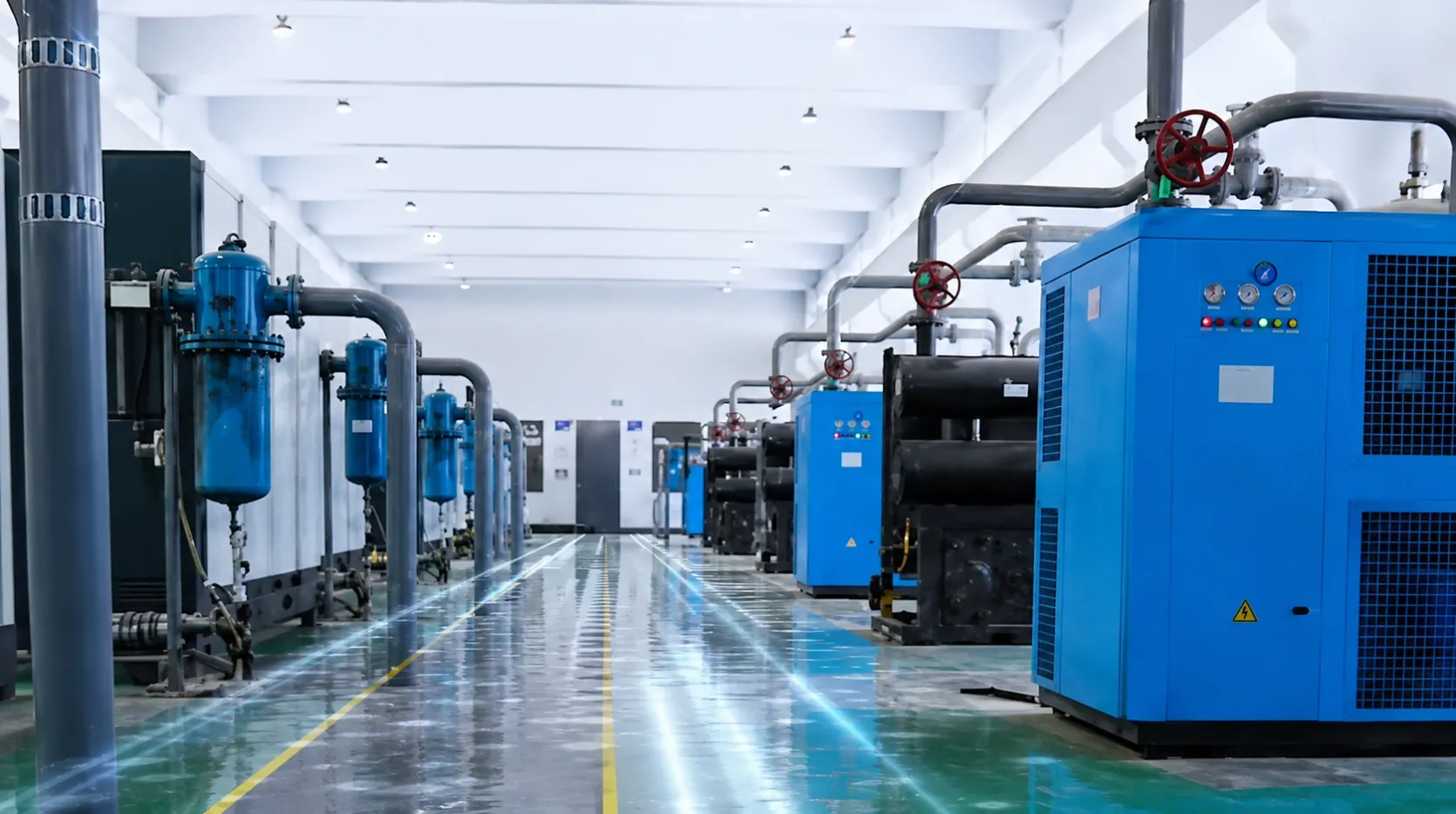
Water in an air line, sticking pneumatic valves and contaminated blow-off air can all point to problems with compressed air quality.
Choosing the right compressed air treatment equipment starts with understanding what your application needs. Adding more filters alone will not solve every problem. Liquid water, water vapor, oil aerosols and solid particles require different treatment methods.
This guide explains what each component does and how to select a practical combination for your equipment.
What Needs to Be Removed from Compressed Air?
Compressed air may contain contaminants from the surrounding atmosphere, the compressor and the distribution pipework.
Contaminant | Possible source | Treatment approach |
|---|---|---|
Liquid water | Condensation as compressed air cools | Liquid separation and reliable drainage |
Water vapor | Moisture in the intake air | Refrigerated, desiccant or other suitable drying |
Oil droplets and aerosols | Compressor lubricant or upstream contamination | Suitable separation and coalescing filtration |
Oil vapor | Hydrocarbons in the intake air or compressor system | Suitable adsorption treatment, where required |
Solid particles | Dust, pipe rust, scale and equipment wear | Particulate filtration |
A water separator removes liquid water. It does not remove water vapor or reduce pressure dew point in the same way as a dryer.
Similarly, a coalescing filter captures liquid aerosols but should not be treated as a complete solution for oil vapor.
Start with the Equipment’s Air Quality Requirements
Before selecting a dryer or filter, check the requirements of the machine and the process.
Useful information includes:
- Required inlet pressure during operation
- Peak and average airflow
- Maximum acceptable moisture, oil and particle levels
- Lowest temperature the downstream pipework will reach
- Whether compressed air contacts the product or finished surface
- Operating hours and seasonal changes
A pneumatic cylinder, a spray gun and an air-bearing measuring machine may require different air treatment arrangements.
Where an ISO 8573-1 specification is required, identify the particle, water and oil requirements separately. A general description such as “clean air” or “precision filtration” is not enough for equipment selection.
What Does Each Treatment Component Do?
Air Receiver: Storage and Condensate Collection
An air receiver helps buffer changes in demand. As compressed air cools, some moisture may condense and collect at the bottom.
That liquid needs a reliable discharge path. An automatic condensate drain can reduce dependence on manual draining.
However, a receiver does not replace a dryer. Water vapor can remain in the air after collected liquid has been discharged.
Water Separator: Remove Bulk Liquid
A compressed air water separator removes entrained liquid droplets from the airflow.
Depending on its design and rating, it may be installed after an aftercooler or near the equipment that needs protection.
Selection should consider operating pressure, airflow range, inlet temperature and drainage arrangements. Connection size alone does not establish whether a separator is suitable.
Air Dryer: Control Water Vapor
A dryer reduces moisture in the compressed air so that condensation is less likely under the intended operating conditions.
The key selection parameter is pressure dew point: the temperature at which water vapor begins to condense at the stated pressure.
The specified pressure dew point should be below the lowest expected downstream air temperature, with an appropriate operating margin.
Dryer type | Typical selection reason | What to evaluate |
|---|---|---|
Refrigerated dryer | General industrial applications with moderate drying requirements | Inlet temperature, ambient conditions, airflow and required dew point |
Desiccant dryer | Applications needing a lower pressure dew point | Regeneration method, purge air or heating requirements, pretreatment and maintenance |
Select the dryer using corrected capacity for actual operating conditions. A nominal airflow rating may not apply when inlet temperature or pressure changes.
Filters: Match the Filter to the Contaminant
Different filters serve different purposes.
Particulate filters capture solid contamination. Coalescing filters capture fine liquid aerosols. Adsorption stages may be needed when oil vapor control is required.
Filter selection should consider both air quality and pressure drop. Excessive restriction can reduce pressure available to the machine.
Follow the manufacturer’s replacement interval and operating limits. Differential pressure is useful for identifying restriction, but it does not prove that every aspect of filtration performance remains satisfactory.
Automatic Drains: Remove the Liquid Already Collected
Separators, receivers and filter housings need functioning drains. If collected condensate cannot leave, it can accumulate and impair treatment performance.
Common options include timer-controlled, mechanical float and electronic level-controlled drains.
Choose according to:
- Condensate volume and contamination
- Minimum and maximum operating pressure
- Power availability
- Installation orientation
- Discharge backpressure
- Access for inspection and servicing
Repeated blockage may indicate that the drain passage, installation or condensate-handling capacity is unsuitable.
Why Can Water Still Reach a Machine After Central Treatment?
Water at the machine inlet is a reason to check the complete system.
Possible causes include:
- Dryer capacity does not match actual conditions.
- Downstream air cools below its pressure dew point.
- A drain is blocked or malfunctioning.
- Liquid has accumulated in low sections of pipework.
- Untreated air enters through an open bypass.
- Existing water remains in the distribution network.
A point-of-use precision air separator can provide additional protection against entrained liquid near the machine inlet. It should be used alongside appropriate central treatment and investigation of the moisture source.
For CNC machines and automated equipment, this can be relevant to air supplies serving tool changes, pneumatic fixtures, valves and blow-off applications.
How to Control Treatment Costs Without Compromising Reliability
A practical system meets the required air quality while avoiding unnecessary restrictions and operating expense.
Treat each application according to its needs. A particularly demanding process may justify dedicated treatment rather than the same specification for every air outlet.
Check pressure during production. Confirm that dryers, filters, regulators and pipework can support simultaneous demand.
Keep drainage reliable. A drain stuck open wastes compressed air; a blocked drain allows liquid to accumulate.
Allow maintenance access. Filters and drains need space for inspection, isolation and servicing.
Compare total operating cost. Include energy, replacement elements, regeneration requirements and maintenance—not only purchase price.
Frequently Asked Questions
Do I need both a dryer and a water separator?
They perform different jobs. A dryer controls water vapor, while a separator removes liquid droplets. The required arrangement depends on the system and the equipment’s air quality specification.
Can an automatic drain remove moisture from the air?
An automatic drain discharges collected condensate. It does not remove water vapor from the airflow.
Does installing more filters always improve the system?
Additional filtration may be necessary for a specific contaminant, but each stage must have a defined purpose. Unnecessary or undersized filters can increase restriction and maintenance costs.
Where should a point-of-use separator be installed?
It is generally installed upstream of the equipment it protects, following the manufacturer’s requirements for orientation, airflow, pressure and drainage. Leave enough space for inspection and servicing.
Need Help Selecting Equipment for Your Air System?
ENHUI TECH supplies point-of-use precision air separators and automatic condensate drains for industrial compressed air applications.
Send your operating conditions to request a product recommendation and quotation.