
Compressed Air Basics
Compressed Air Treatment System: A Practical Guide to Equipment Layout
Learn how to arrange a compressed air treatment system, from receivers and dryers to filters and point-of-use separators, to help protect your machines from contamination.
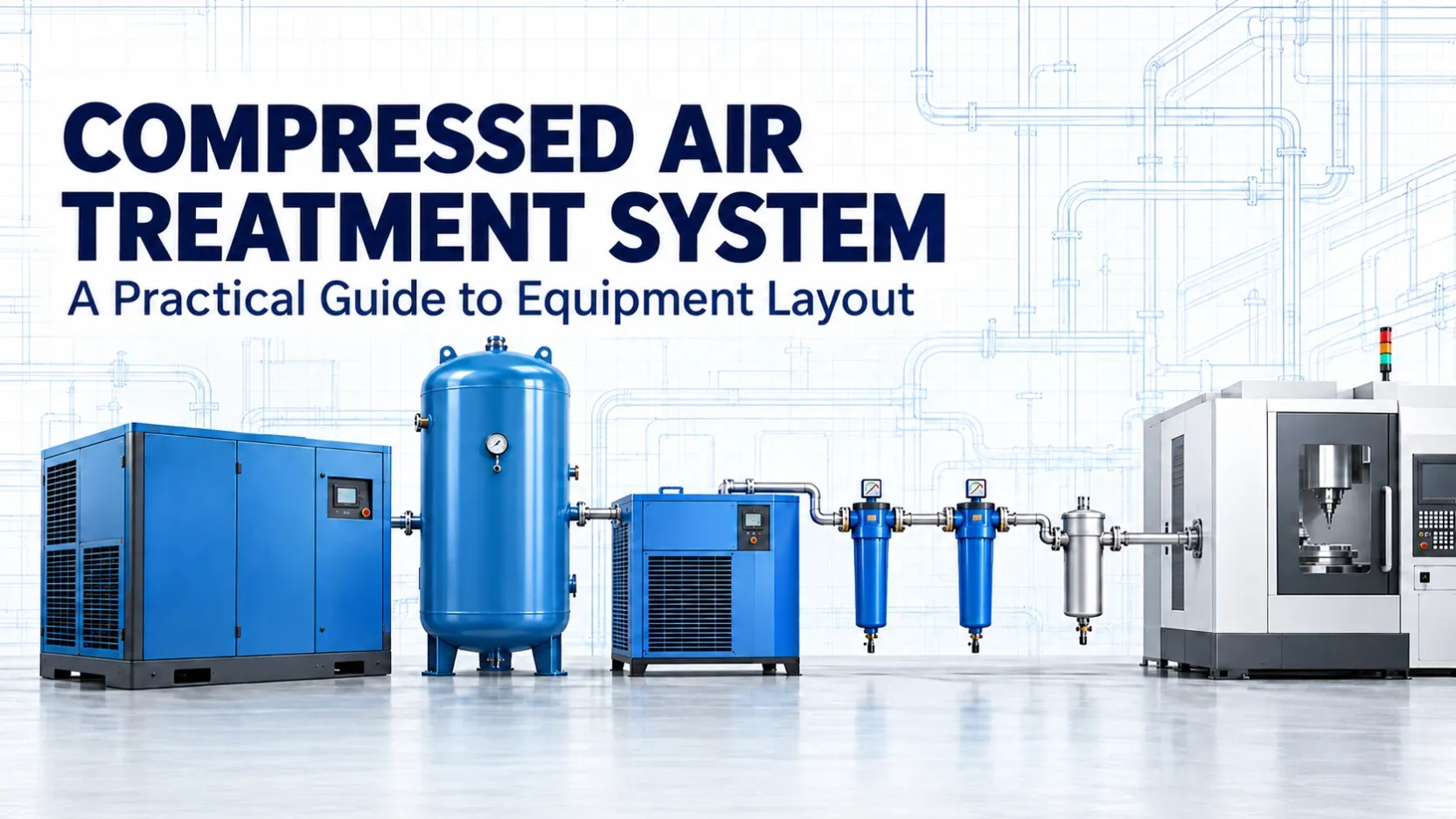
Compressed air often carries moisture, oil and particles that can affect tools, valves and production equipment. A properly arranged treatment system helps reduce these contaminants before the air reaches the machine.
But where should the air receiver go? Why are filters installed before and after the dryer? And what is the purpose of a separator at the equipment inlet?
This guide explains a typical compressed air treatment layout and the role of each stage.
1. A Typical Compressed Air Treatment Flow
One common arrangement is:
Air compressor → Aftercooler and water separator → Wet air receiver → Pre-filter → Air dryer → After-filter, where required → Distribution piping → Point-of-use treatment → Machine
This is an example, rather than a fixed layout for every installation. Some compressors already include an aftercooler and water separator. Some systems also have a dry air receiver after the dryer.
The final arrangement should match the compressor, dryer, air demand and requirements of the equipment being supplied.
2. Cooling and Removing Bulk Water
Air leaving a compressor is hot. As it cools, some of the water vapor turns into liquid water.
An aftercooler lowers the air temperature, while a water separator removes much of the liquid formed during cooling. The collected liquid is discharged through a drain.
Removing this water early reduces the liquid load on downstream equipment. However, the air still contains water vapor, so a separator alone cannot replace the drying stage.
3. The Air Receiver: Before or After the Dryer?
An air receiver stores compressed air and helps the system handle changes in demand. Its position determines what other benefits it provides.
Before the dryer: a wet receiver
A wet receiver stores air that has not yet been dried. It allows some additional cooling and collects condensate, which must be drained regularly.
However, a sudden increase in demand can draw stored air through the dryer faster than its rated capacity. The receiver and dryer therefore need to be sized together.
After the dryer: a dry receiver
A dry receiver stores air that has already been treated. It can supply short periods of increased demand without requiring all that air to pass through the dryer at the same moment.
Both arrangements are valid, and some installations use both. There is no universal rule that every receiver must go before the dryer.
4. Filters Protect the Dryer and Downstream Equipment
Filters perform different jobs depending on their design.
Before the dryer, suitable filters help reduce particles and oil aerosols that could contaminate internal components. This is particularly important for adsorption dryers, whose drying material needs protection from contamination.
After the dryer, additional filtration may be needed. For example, an adsorption dryer can require a dust filter to capture particles released by its drying material.
Select filters according to their function and the equipment manufacturer’s requirements. Labels such as C, T and A are not universal filter grades and may mean different things across brands.
Adding more filters is not always better. Each stage adds pressure loss and maintenance requirements, so every filter should have a clear purpose.
5. The Dryer Reduces Water Vapor
The dryer handles moisture that liquid separators cannot remove: water vapor.
Two common types are:
Dryer type | How it works | Typical reason for choosing it |
|---|---|---|
Refrigerated dryer | Cools the air so moisture condenses and can be separated and drained. | General industrial applications where its drying performance meets the operating conditions. |
Adsorption dryer | Uses a drying material to capture water vapor. | Applications needing a lower pressure dew point, including some cold environments and moisture-sensitive processes. |
The aim is to dry the air enough to prevent unwanted condensation under the expected downstream conditions.
A refrigerated dryer and an adsorption dryer do not always need to be installed together. The choice depends on the required dryness, inlet conditions and application.
6. Final Protection at the Machine Inlet
Central treatment serves the factory, but the air still travels through distribution piping before reaching individual machines.
Residual liquid may remain in the system. Further condensation can also occur if the compressed air cools below its pressure dew point. This makes equipment-side protection useful where liquid contamination could disrupt operation.
The ENHUI TECH Point-of-Use Precision Air Separator is designed to remove liquid water, oil droplets and particles close to the machine inlet.
Its features include:
- Up to 99.999% liquid water separation efficiency
- Removes liquid water, oil droplets, and particles down to 1 μm
- No filter element replacement required
- Minimal maintenance required
- Compact design and easy installation
- Consistent separation performance over time
- Long service life (10–20 years)
It can provide additional protection for CNC machines, pneumatic tools, valves, cylinders and automation equipment.
A typical equipment-side arrangement is:
Distribution piping → ENHUI precision air separator → Additional treatment or pressure regulation as required → Machine
Install the separator close to the equipment and keep the downstream connection reasonably short. Leave enough space to inspect the unit and ensure the drain can discharge properly.
The separator complements the central treatment system. It does not replace a dryer, remove water vapor in the same way, or replace specialized oil-vapor or sterile filtration.
7. Check the Complete System Before Installation
Before selecting or adding treatment equipment, review these practical points:
Air demand: Use the machine’s operating and peak flow requirements, together with the pressure at the installation point.
Required air quality: Follow the machine manufacturer’s requirements. General pneumatic tools, paint spraying and sensitive measurement equipment may need different treatment.
Pressure loss: Check the combined pressure drop across filters, separators, dryers, piping and fittings. The machine needs sufficient pressure while operating, not only while idle.
Drainage: Collected water must leave the system. Inspect receiver, filter and separator drains for blockage or continuous air leakage.
Maintenance access: Position equipment so drains, filter elements and inspection points remain accessible.
A well-designed system gives each stage a clear job: cooling and bulk water separation, storage, filtration, drying and final protection at the point of use.
To add liquid protection at your machine inlet, explore the ENHUI TECH precision air separator range. Share your operating pressure, airflow and application with us to help identify a suitable model.