
Jun 26, 2026Compressed Air Problems
Compressed Air Treatment Equipment Market Trends: Why Clean and Dry Air Is Becoming More Important in Modern Industry
Explore trends in the compressed air treatment equipment market, including air quality compliance, and the growing demand for filters, dryers, aftercoolers, and condensate drainage solutions.
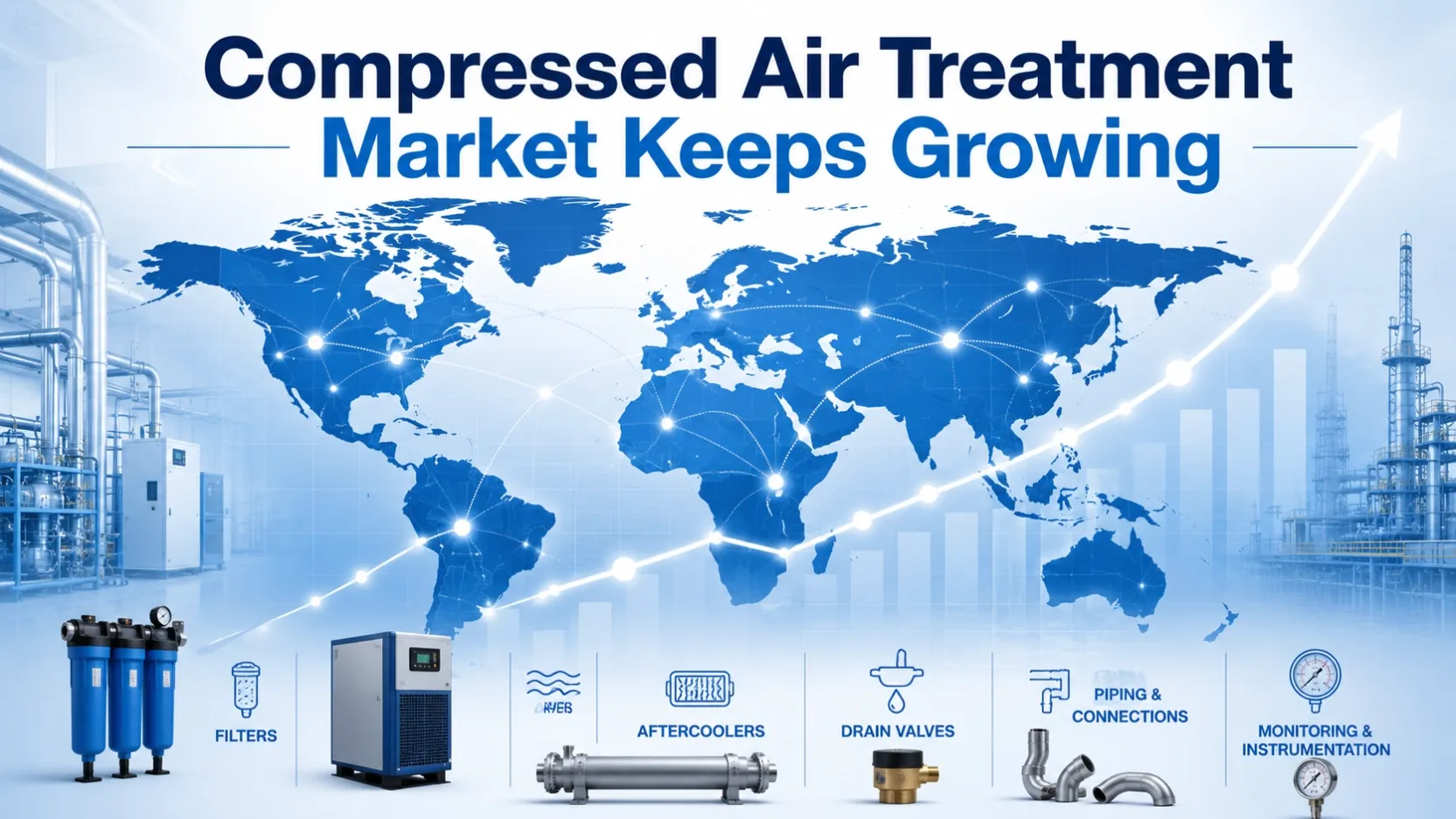
Compressed air is widely used across modern industry. It powers pneumatic tools, production equipment, automation systems, packaging machines, conveying systems, process equipment, and many other factory applications.
However, compressed air is not naturally clean or dry.
During compression, air can carry moisture, oil aerosols, solid particles, and other contaminants. If these contaminants are not properly controlled, they may affect machine reliability, product quality, maintenance cost, and production stability.
This is one reason why compressed air treatment equipment is becoming increasingly important.
According to a market report by Global Growth Insights, the global compressed air treatment equipment market is expected to continue growing through 2035, supported by industrial automation, energy efficiency requirements, and stricter air quality compliance standards.
This trend reflects a broader change in the way factories view compressed air.
Compressed air is no longer only considered a utility for powering machines. It is becoming part of production quality, equipment protection, energy management, and industrial reliability.
What Is Compressed Air Treatment Equipment?
Compressed air treatment equipment refers to the devices used to improve compressed air quality before the air reaches production equipment or industrial processes.
The main product categories include:
- Compressed air filters
- Air dryers
- Aftercoolers
- Condensate drains
- Mist eliminators
- Other auxiliary air treatment equipment
Each product has a different role in the compressed air system.
Filters help remove particles, oil aerosols, and other contaminants. Air dryers help control moisture. Aftercoolers reduce the temperature of compressed air after compression. Drain valves and condensate management devices help remove liquid water from the system.
Together, these products help deliver cleaner, drier, and more reliable compressed air to downstream equipment.
Why the Market Is Growing
The compressed air treatment equipment market is growing because industrial users are paying more attention to air quality and system efficiency.
Several factors are driving this growth.
1. Industrial Automation
As factories become more automated, compressed air quality becomes more important.
Automation equipment often depends on pneumatic valves, cylinders, actuators, sensors, and control systems. Moisture, oil, and particles in compressed air may lead to unstable movement, valve sticking, corrosion, pressure drop, or unexpected equipment failure.
In highly automated production lines, even small air quality problems can affect production efficiency.
This is why manufacturers are investing more in air dryers, filters, drainage systems, and local air treatment solutions.
2. Energy Efficiency Requirements
Compressed air systems consume a significant amount of energy in industrial facilities. Poor system design, pressure drop, leakage, blocked filters, inefficient dryers, and poor condensate management can all increase operating costs.
The report highlights energy efficiency as a major market trend. More companies are looking for air treatment equipment that can help reduce energy waste, improve system stability, and support lower operating costs.
Energy-efficient air treatment is not only about buying one product. It also requires proper system design, correct equipment sizing, regular maintenance, and monitoring of pressure, flow, temperature, and dew point.
3. Air Quality Compliance
Many industries have higher requirements for compressed air quality.
Food and beverage, healthcare, pharmaceuticals, electronics, chemical processing, and precision manufacturing often require cleaner and more stable compressed air. In these applications, contamination may affect product quality, hygiene, equipment performance, or process reliability.
Air treatment equipment helps control moisture, oil, and particles so that compressed air can better meet the needs of different industrial applications.
4. Growing Awareness of Moisture Problems
Moisture is one of the most common problems in compressed air systems.
When air is compressed, the amount of water vapor per unit volume increases. As compressed air cools, water vapor may condense into liquid water. If this water is not removed effectively, it can travel through pipelines and enter machines.
Liquid water in compressed air may cause:
- Corrosion inside pipelines and equipment
- Unstable pneumatic valve operation
- Cylinder movement problems
- Damage to air tools
- Product quality issues
- Increased maintenance requirements
- Unplanned downtime
This is why air dryers, aftercoolers, moisture separators, and condensate drains are essential parts of compressed air treatment systems.
Key Product Categories in Compressed Air Treatment
Filters
Compressed air filters are widely used in industrial compressed air systems. They help remove solid particles, oil aerosols, and other contaminants from compressed air.
Different applications may require different filtration levels. For example, general pneumatic tools may require a different air quality level compared with food processing, pharmaceutical production, electronics manufacturing, or precision instruments.
Common filter types include particulate filters, coalescing filters, and activated carbon filters.
Dryers
Compressed air dryers are used to reduce moisture-related problems. Common dryer technologies include refrigerated dryers, desiccant dryers, and membrane dryers.
Refrigerated dryers are widely used in general industrial applications because they are practical and cost-effective for many factory air systems.
Desiccant dryers are often used where lower dew points are required, such as pharmaceutical production, electronics manufacturing, laboratory systems, or instrument air applications.
The right dryer should be selected based on required pressure dew point, airflow, operating pressure, inlet temperature, and application requirements.
Aftercoolers
Aftercoolers reduce the temperature of compressed air after it leaves the compressor. When hot compressed air is cooled, part of the water vapor condenses into liquid water, which can then be separated and drained.
Aftercoolers are important because they reduce the moisture load on downstream air treatment equipment.
A properly installed aftercooler can help improve the performance of dryers, filters, and moisture separators.
Condensate Drains and Auxiliary Equipment
Condensate drains remove liquid water from air receivers, filters, dryers, separators, and pipeline low points.
If drains fail or are not maintained, water can accumulate and be carried downstream. This may create the impression that the dryer or filter is not working properly, when the real problem is poor condensate removal.
Automatic drain valves, mist eliminators, and other auxiliary devices help support stable air quality and reduce manual maintenance.
Important Application Industries
The report identifies several major application industries for compressed air treatment equipment.
Food and Beverage
Food and beverage facilities often use compressed air in packaging, conveying, filling, cleaning, and production equipment.
In these environments, air quality may affect hygiene, product safety, and process reliability. Moisture and oil contamination must be controlled carefully.
Air dryers, sterile filters, coalescing filters, and condensate management equipment can all play important roles in food and beverage compressed air systems.
Healthcare and Pharmaceuticals
Healthcare and pharmaceutical applications often require high-purity compressed air. In some cases, compressed air is used in laboratories, cleanrooms, packaging, medical systems, and production processes.
These applications may require oil-free air, low moisture levels, and strict contamination control.
This creates demand for advanced filtration, drying, and monitoring solutions.
Chemical Industry
Chemical plants may require clean and dry compressed air for process control, instrumentation, conveying, and production equipment.
Compressed air contamination can affect process safety, equipment reliability, and product consistency.
Oil-free air treatment, moisture control, and reliable filtration are important in many chemical applications.
Paper Industry
Paper mills use compressed air for drying, conveying, control valves, actuators, and production machinery.
Air quality and energy efficiency are both important because these systems often operate continuously and consume large volumes of compressed air.
Efficient air treatment can help reduce downtime and support stable production.
Electronics and Precision Manufacturing
Electronics manufacturing often requires low-moisture compressed air because moisture can affect precision processes, sensitive components, and production quality.
Desiccant dryers, fine filtration, and local point-of-use air treatment may be used depending on the required air quality level.
Regional Trends: Why Asia-Pacific Matters
The report highlights Asia-Pacific as a major region in the compressed air treatment equipment market.
This is closely connected to industrial expansion, manufacturing growth, and increasing automation in countries such as China, India, and Japan.
As manufacturing capacity expands, demand for compressed air systems also increases. As factories upgrade production lines, they often require better air quality, better system efficiency, and more reliable equipment protection.
For suppliers, distributors, and industrial equipment companies, Asia-Pacific remains an important market for air dryers, filters, aftercoolers, drain valves, and other compressed air treatment products.
Technology Trends in Compressed Air Treatment
The compressed air treatment equipment market is also being shaped by new technology trends.
Smart Monitoring
Smart monitoring and IoT-enabled systems are being integrated into more compressed air treatment equipment.
These systems can help monitor:
- Pressure
- Flow
- Temperature
- Dew point
- Filter condition
- Drain performance
- Energy consumption
This allows users to detect problems earlier and move from reactive maintenance to predictive maintenance.
Energy-Saving Dryers and Filters
Energy-saving air dryers and high-efficiency filters are gaining more attention as factories try to reduce operating costs.
A good air treatment system should not only provide cleaner air. It should also help maintain reasonable pressure drop and system efficiency.
Oil-Free and High-Purity Air Solutions
Industries such as food and beverage, healthcare, pharmaceuticals, electronics, and clean manufacturing are increasing demand for oil-free and high-purity compressed air solutions.
This creates opportunities for advanced filtration, drying, oil removal, and air quality monitoring technologies.
Modular Air Treatment Systems
Modular compressed air treatment systems allow users to configure dryers, filters, drains, and other components based on actual application requirements.
This is useful because different machines or processes may require different air quality levels.
Instead of treating the entire factory to the highest possible air quality, users can combine central air treatment with local point-of-use protection where needed.
Why Point-of-Use Air Treatment Is Becoming More Relevant
Central air treatment is important, but air quality problems may still occur at the point where compressed air is actually used.
Compressed air may continue to cool as it travels through long pipelines. Water can accumulate in low points. Drain valves may fail. Local equipment may require better air quality than the rest of the factory.
This is why point-of-use air treatment can be valuable.
A point-of-use air dryer or moisture separator is installed close to the machine inlet. It provides an additional layer of protection before compressed air enters sensitive equipment.
This approach can be useful for:
- CNC machines
- Automation equipment
- Pneumatic valves and cylinders
- Packaging machines
- Air tools
- Electronics manufacturing equipment
- Food processing equipment
- Precision instruments
Point-of-use treatment should not always be considered a replacement for central dryers and filters. In many systems, it works as a complementary solution that helps improve air quality near critical machines.
What This Means for Industrial Users
For industrial users, the key question is not only:
“Do we have compressed air?”
The more important question is:
“Is the compressed air clean, dry, and reliable enough at the point where it is actually used?”
A well-designed compressed air treatment system can help improve:
- Equipment reliability
- Production stability
- Air quality compliance
- Maintenance efficiency
- Energy performance
- Product quality
As industrial automation and quality requirements continue to grow, compressed air treatment will become an even more important part of factory infrastructure.
Conclusion
The compressed air treatment equipment market is growing because industrial users are placing greater value on clean, dry, and reliable compressed air.
Filters, dryers, aftercoolers, condensate drains, and auxiliary equipment all play important roles in controlling moisture, oil, particles, and other contaminants.
At the same time, energy efficiency, smart monitoring, oil-free solutions, and modular system design are shaping the future of compressed air treatment.
For factories, compressed air is not just a power source. It is part of equipment reliability, production quality, and long-term operational performance.
Clean air. Dry air. Stable production.
That is the direction modern compressed air systems are moving toward.
Reference: This article is based on market information and industry trends summarized from the Global Growth Insights “Compressed Air Treatment Equipment Market” report.