
Jun 26, 2026Compressed Air Basics
Components of a Compressed Air Purification System: From Contaminated Air to Clean Air Supply
Compressed air purification systems remove moisture, oil mist, and particles through filters, dryers, separators, and final filters, providing clean, reliable air for industrial equipment.
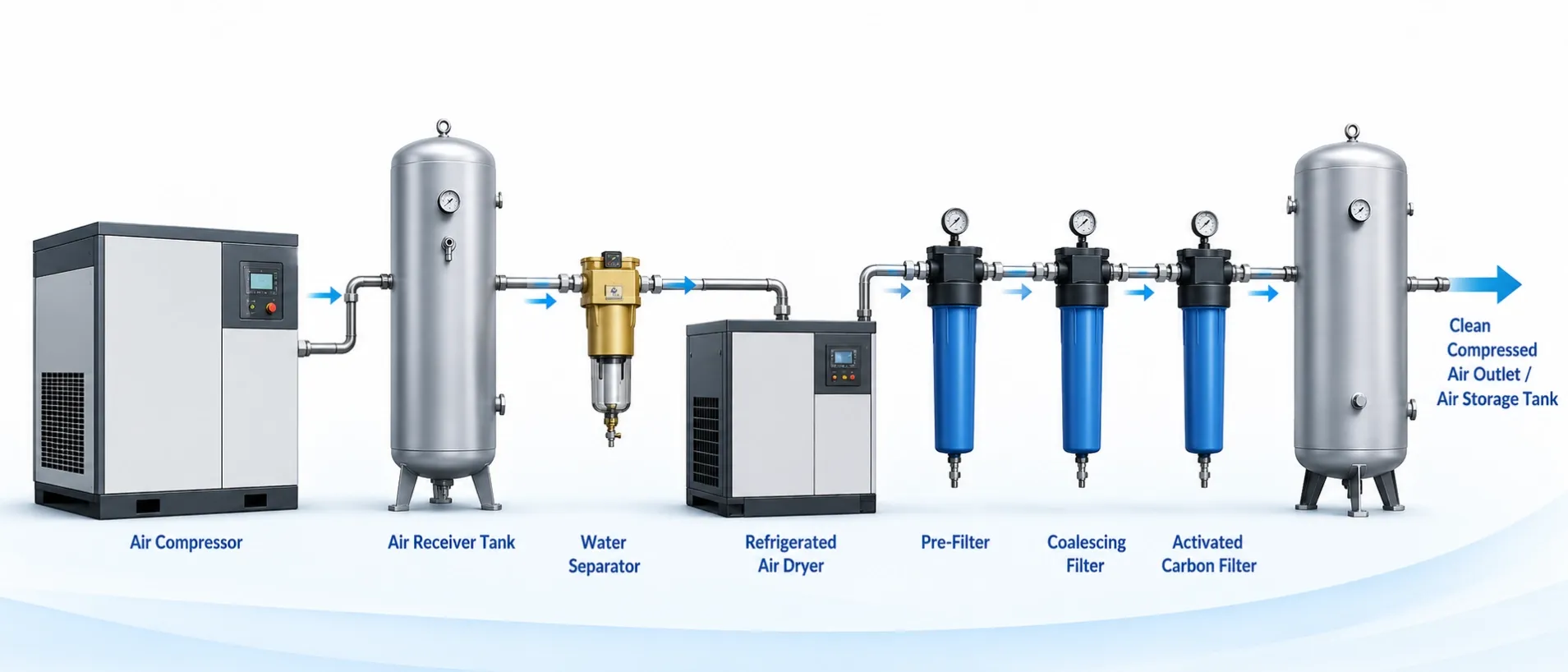
Components of a Compressed Air Purification System: From Contaminated Air to Clean Air Supply
Compressed air is not naturally “clean air.” Air discharged from an air compressor often contains water vapor, oil mist, dust particles, and other contaminants. If these impurities are delivered directly to pneumatic equipment, they may cause tool wear, frequent malfunctions, damage to precision instruments, or even product defects, such as poor soldering of electronic components or oil spots on painted surfaces.
A compressed air purification system is designed to work through multiple treatment stages, converting contaminated compressed air into a clean and reliable air supply that meets production requirements.
This article explains the five key modules of a compressed air purification system, including their functions, working principles, selection points, and typical application configurations.
1. Pre-filter: Removing Large Particles and Protecting Downstream Equipment
Main Function
The pre-filter is the first line of defense in a compressed air purification system. It is mainly used to remove solid particles of 10 μm and above, such as dust, metal particles, and other large contaminants. It can also separate part of the liquid water and oil droplets from the compressed air.
By removing large impurities at an early stage, the pre-filter helps protect downstream equipment such as air dryers and precision filters from blockage, wear, and premature failure.
Working Principle
A pre-filter usually works through a combination of inertial impaction and gravity separation.
When compressed air enters the filter, the airflow is guided into a rotating motion. Larger particles, due to their higher inertia, cannot follow the change in airflow direction and are thrown against the inner wall of the filter housing. They then settle at the bottom of the filter.
Liquid water and oil droplets also collect and settle under gravity, and are discharged through the drain valve at the bottom of the filter.
Selection and Maintenance Tips
For filtration accuracy, a 10 μm pre-filter is commonly recommended. It works together with the compressor intake filter to form a two-stage coarse filtration protection.
For filter materials, glass fiber or polyester fiber elements are commonly used because they are resistant to oil and suitable for compressed air systems operating below 80°C. For the filter housing, aluminum alloy or stainless steel is preferred to reduce the risk of rust contamination.
For maintenance, the pressure drop across the filter element should be checked regularly. If the pressure drop exceeds 0.05 MPa, the filter element should be replaced. Manual drainage should be carried out once or twice a week, or an automatic drain valve can be installed to prevent condensate and contaminants from accumulating.
2. Air Dryer: Removing Water Vapor and Preventing Condensation
Main Function
Water vapor in compressed air is a hidden risk. When the temperature drops, water vapor may condense into liquid water, causing pipeline corrosion, rust in pneumatic components, short circuits in precision instruments, and unstable production quality.
The main function of an air dryer is to reduce the pressure dew point of compressed air. In many industrial applications, the dew point is commonly controlled below -20°C, while higher-demand applications may require a dew point of -40°C or lower. This helps prevent condensation during air transmission and use.
Common Types and Working Principles
Two types of air dryers are widely used in industrial compressed air systems.
Refrigerated Air Dryer
A refrigerated air dryer removes moisture through cooling. It is suitable for most general industrial applications, such as automotive repair, hardware processing, and general pneumatic equipment.
Compressed air first enters a heat exchanger for pre-cooling. It then passes through an evaporator, where it is cooled by the refrigeration system to around 5°C. As the temperature drops, water vapor condenses into liquid water and is discharged through a separator and drain valve. Finally, the air is reheated through the heat exchanger before being delivered downstream, helping to avoid condensation on the pipeline surface.
Refrigerated air dryers are cost-effective and easy to maintain. However, they are generally not suitable for applications requiring very low dew points such as -40°C or below.
Desiccant Air Dryer
A desiccant air dryer removes moisture through adsorption. It is suitable for applications with higher air quality requirements, such as electronics, pharmaceuticals, food processing, and precision manufacturing.
Compressed air passes through an adsorption tower filled with desiccant materials such as activated alumina, silica gel, or molecular sieve. Water vapor is captured by the desiccant. When one tower becomes saturated, the system automatically switches to another tower, while the saturated tower is regenerated using dry purge air.
Desiccant air dryers can achieve very low pressure dew points, typically from -40°C to -70°C. Their advantage is deep moisture removal, but they have higher initial cost and require regular desiccant replacement or maintenance.
Selection Tips
The dryer type should be selected according to the required dew point. For general applications, a refrigerated air dryer is usually sufficient. For electronics, pharmaceuticals, food, or other high-precision applications, a desiccant air dryer is more suitable.
The dryer capacity should also match the compressor flow rate. In general, the rated air flow of the dryer should be 10% to 20% higher than the compressor capacity. For example, if the compressor output is 1 m³/min, a dryer rated at around 1.2 m³/min is recommended to avoid overload and unstable drying performance.
3. Precision Filter: Removing Fine Oil Mist and Small Particles
Main Function
After the pre-filter and air dryer, compressed air may still contain fine oil mist of 0.1 to 1 μm and small particles of 0.1 to 5 μm. These contaminants may cause oil spots in painting applications, wear in precision cylinders, and quality issues in sensitive production processes.
The function of the precision filter is to further remove fine oil mist and small particles, improving the cleanliness of the compressed air supply. In many applications, the residual oil content needs to be reduced below 0.1 mg/m³, and particle filtration accuracy may need to reach 0.1 μm.
Working Principle
Precision filters usually use a combination of depth filtration and membrane filtration.
The filter element is made of multiple layers of glass fiber, PTFE membrane, or other high-efficiency filter media. When compressed air passes through the filter element, fine oil mist and particles are intercepted, captured, and coalesced by the filter fibers.
Some filter elements also use hydrophobic surface treatment to reduce oil adhesion and maintain stable filtration performance.
Common Grades and Applications
Precision filters are usually classified by filtration accuracy and residual oil content. They are often used in combination according to application requirements.
Q grade pre-precision filter
Filtration accuracy: around 5 μm.
Used to remove liquid oil and coarse particles, protecting downstream high-efficiency filters.
P grade oil mist filter
Filtration accuracy: around 1 μm.
Residual oil content can be reduced to below 1 mg/m³.
Suitable for pneumatic tools and general pneumatic cylinders.
S grade high-efficiency filter
Filtration accuracy: around 0.1 μm.
Residual oil content can be reduced to below 0.1 mg/m³.
Suitable for painting, printing, and precision pneumatic equipment.
C grade activated carbon filter
Used to adsorb residual oil vapor and odor.
Residual oil content can be reduced to as low as 0.003 mg/m³.
Suitable for electronics, food, pharmaceutical, and other high-cleanliness applications.
Maintenance Tips
The replacement cycle should be determined according to operating conditions. For general applications, the filter element is usually replaced every six months. In high-oil applications, such as systems using piston compressors, replacement every three months may be required.
Moisture should be avoided. If the air dryer fails, the system should be checked immediately, because wet compressed air may cause filter element contamination, mold growth, and reduced filtration performance.
4. Oil-Air Separator: Separating Lubricating Oil from Oil-Injected Compressors
Main Function
Oil-injected screw compressors and piston compressors use lubricating oil during the compression process. A small amount of oil may enter the compressed air stream, with typical oil content ranging from 5 to 15 mg/m³.
If this oil enters the dryer and precision filters directly, it may contaminate the desiccant, block filter elements, and reduce the efficiency of the purification system.
The oil-air separator is designed to remove most of the lubricating oil at an early stage, typically separating more than 80% of the oil and reducing the oil content to around 1 to 3 mg/m³. This helps reduce the load on downstream purification equipment.
Working Principle
An oil-air separator usually combines centrifugal separation and mesh filtration.
First, compressed air enters the separator and flows at high speed along the inner wall. Under centrifugal force, lubricating oil is thrown onto the inner wall and collected at the bottom oil chamber.
Second, the air passes through an internal mesh or coalescing filter element to remove remaining fine oil mist.
Finally, the separated oil is returned to the compressor air end through an oil return line for reuse.
Selection and Maintenance Tips
Oil-air separators are mainly required for oil-injected compressors, such as screw compressors and piston compressors. Oil-free compressors generally do not require this module.
Maintenance should focus on the separator element and the oil return line. The separator element is usually replaced every 6 to 12 months, depending on compressor operating hours. The oil return line should be checked regularly to prevent blockage, which may cause oil loss or insufficient lubrication inside the compressor.
5. Final Filter: Final Protection for Special Application Requirements
Main Function
After precision filtration, some special production environments still require final filtration at the point of use. Applications such as semiconductor packaging, sterile food packaging, pharmaceutical production, and high-end electronics manufacturing may require compressed air that meets strict industry standards.
A final filter provides terminal filtration to ensure the air quality meets specific process requirements.
Common Types and Applications
Sterile Filter
Sterile filters usually use PES membrane filter elements with a filtration accuracy of 0.22 μm. They can remove bacteria and microorganisms from compressed air and are commonly used in pneumatic filling, food processing, and pharmaceutical applications.
Ultra-clean Filter
Ultra-clean filters use high-efficiency filter media such as HEPA materials. With a filtration accuracy around 0.3 μm and filtration efficiency up to 99.97%, they are suitable for semiconductor packaging and other ultra-clean applications.
Odor Removal Filter
Odor removal filters are filled with activated carbon or molecular sieve materials. They are used to adsorb unpleasant odors, oil vapor, and other gaseous contaminants in compressed air. They are commonly used in food, cosmetics, and pneumatic coding or printing applications.
Selection Tips
The final filter should be selected according to industry standards and production requirements. Food and pharmaceutical applications may require sterile filters, while electronics and semiconductor applications may require ultra-clean filters.
Sterile filters should be sterilized or replaced regularly. For example, sterilization may be carried out every three months using steam or disinfectant, while ultra-clean filters are often replaced every six months to ensure stable filtration performance.
6. Typical Compressed Air Purification System Configurations
Different industries have different requirements for compressed air quality. The following are common configuration examples.
General Applications
Suitable for automotive repair, hardware processing, general pneumatic tools, and ordinary industrial use.
Recommended configuration:
Air compressor → Oil-air separator → Pre-filter → Refrigerated air dryer → P grade precision filter
Painting and Printing Applications
Suitable for spray painting, coating, printing, and applications sensitive to oil mist and moisture.
Recommended configuration:
Air compressor → Oil-air separator → Pre-filter → Refrigerated air dryer → S grade precision filter → C grade activated carbon filter
Electronics, Pharmaceutical, and Food Applications
Suitable for electronics manufacturing, pharmaceutical production, food processing, sterile packaging, and other high-cleanliness applications.
Recommended configuration:
Air compressor → Oil-air separator → Pre-filter → Desiccant air dryer → S grade precision filter → Sterile filter or ultra-clean final filter
Conclusion: A Compressed Air Purification System Should Be Configured According to Real Application Needs
A compressed air purification system is not a fixed combination of equipment. It should be designed according to compressor type, production process, air quality requirements, pressure dew point, residual oil content, and particle filtration accuracy.
When designing a system, it is important to first define the actual production requirements. For example, painting applications may require a pressure dew point of ≤ -20°C and residual oil content of ≤ 0.1 mg/m³.
The general configuration logic is to remove larger contaminants first, then fine contaminants; remove bulk water and moisture before final high-precision filtration; and select the proper filtration grade according to the application.
Over-treatment may increase unnecessary cost, while insufficient purification may lead to equipment damage, production instability, and product quality problems.
Only a properly matched compressed air purification system can turn compressed air into a clean and reliable power source, helping factories maintain stable production, protect equipment, and improve product quality.