
Jul 29, 2026Compressed Air Problems
5 Benefits of Installing a Point-of-Use Compressed Air Liquid Separator
Explore five practical benefits of installing a point-of-use air dryer near CNC machines, pneumatic equipment, and other sensitive applications.
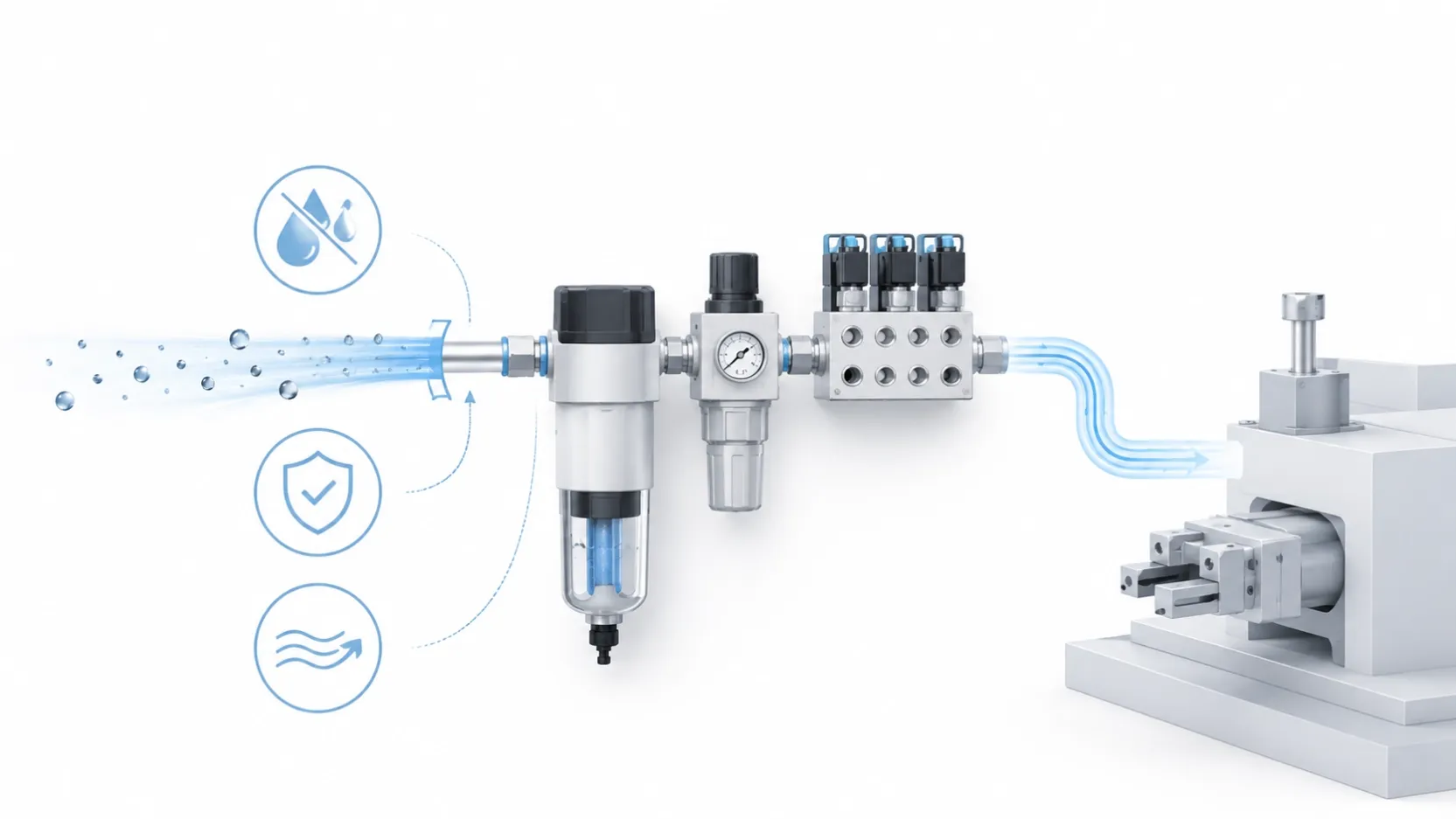
Compressed air often travels a long distance between the compressor room and the machine where it is used.
During this journey, temperature changes, pipeline conditions, drain failures, and operating fluctuations may allow residual liquid water to reach the point of use.
A point-of-use compressed air liquid separator is installed close to the machine inlet to provide localized moisture protection.
Here are five practical benefits of adding point-of-use air treatment to an existing compressed air system.
1. Additional Moisture Protection at the Machine
The main advantage of a point-of-use liquid separator is its installation position.
Because it is located close to the equipment, it can help remove entrained liquid water that has travelled through the downstream pipework or formed after the central dryer.
This is useful for machines located:
- Far from the compressor room
- At the end of a long pipeline
- In areas with significant temperature changes
- Near pipeline low points
- In sections with intermittent air consumption
Treating the air close to the machine reduces the distance between the final moisture-removal stage and the application.
2. Better Protection for Pneumatic Components
Water in compressed air can affect pneumatic components in several ways.
It may contribute to:
- Internal corrosion
- Valve sticking
- Unstable cylinder movement
- Reduced lubrication performance
- Seal deterioration
- Blocked or contaminated small air passages
- Premature wear of air tools
Not every equipment failure is caused by water. However, reducing liquid-water carryover can remove one common source of pneumatic-system problems.
This is especially valuable for equipment that relies on precise and repeatable pneumatic movement.
3. More Targeted Air Treatment
Different areas of a factory may have different compressed-air quality requirements.
For example, general-purpose air blowing may tolerate a different air quality level from:
- Precision measurement equipment
- CNC machine tool systems
- Spray-finishing applications
- Automated control equipment
- Sensitive pneumatic instruments
Treating the entire factory to the strictest local requirement may require a larger investment and more complex system design.
Point-of-use treatment allows additional protection to be applied only to selected machines or production areas.
However, the expected energy or cost savings should be evaluated case by case. They depend on the dryer technology, airflow, operating hours, pressure loss, and existing central system.
4. Easier Integration into Existing Systems
Many point-of-use liquid separator have a compact structure and can be added to an existing compressed air line without major modifications to the central compressor room.
Depending on the model and installation conditions, they may be mounted:
- Near the machine inlet
- On a local compressed air branch
- On an equipment frame
- Near a pneumatic control cabinet
- Before a critical air-consuming component
A compact design is particularly useful where installation space is limited.
Before installation, there must still be enough room for drainage, inspection, pipe connection, and safe maintenance.
5. Lower Maintenance Requirements for Certain Designs
Maintenance requirements vary between dryer technologies.
Desiccant dryers may require desiccant replacement or regeneration. Filters need periodic element replacement. Refrigerated dryers use electrical and refrigeration components.
A centrifugal point-of-use liquid separator can have a simpler operating principle. A design without a replaceable filter element may reduce routine consumable replacement.
Such a product may also operate without electricity, depending on its structure.
Nevertheless, “no filter element” does not mean that the entire compressed air system requires no maintenance. Drainage components, pipelines, upstream filters, and the dryer body should still be inspected periodically.
Other Possible Benefits
Depending on the application, point-of-use moisture protection may also help:
- Reduce unexpected water discharge from equipment
- Improve production stability
- Lower the risk of water-related surface defects
- Support cleaner pneumatic operation
- Reduce troubleshooting caused by variable air quality
- Provide an additional safeguard during central-system fluctuations
The actual benefits depend on the original moisture problem and whether the selected dryer matches the application.